Site Furniture in Winter and Road Salt
Winter is the hardest season on outdoor furniture. Salt, plows, freeze-thaw and snow piles all cause damage that a little planning can prevent.
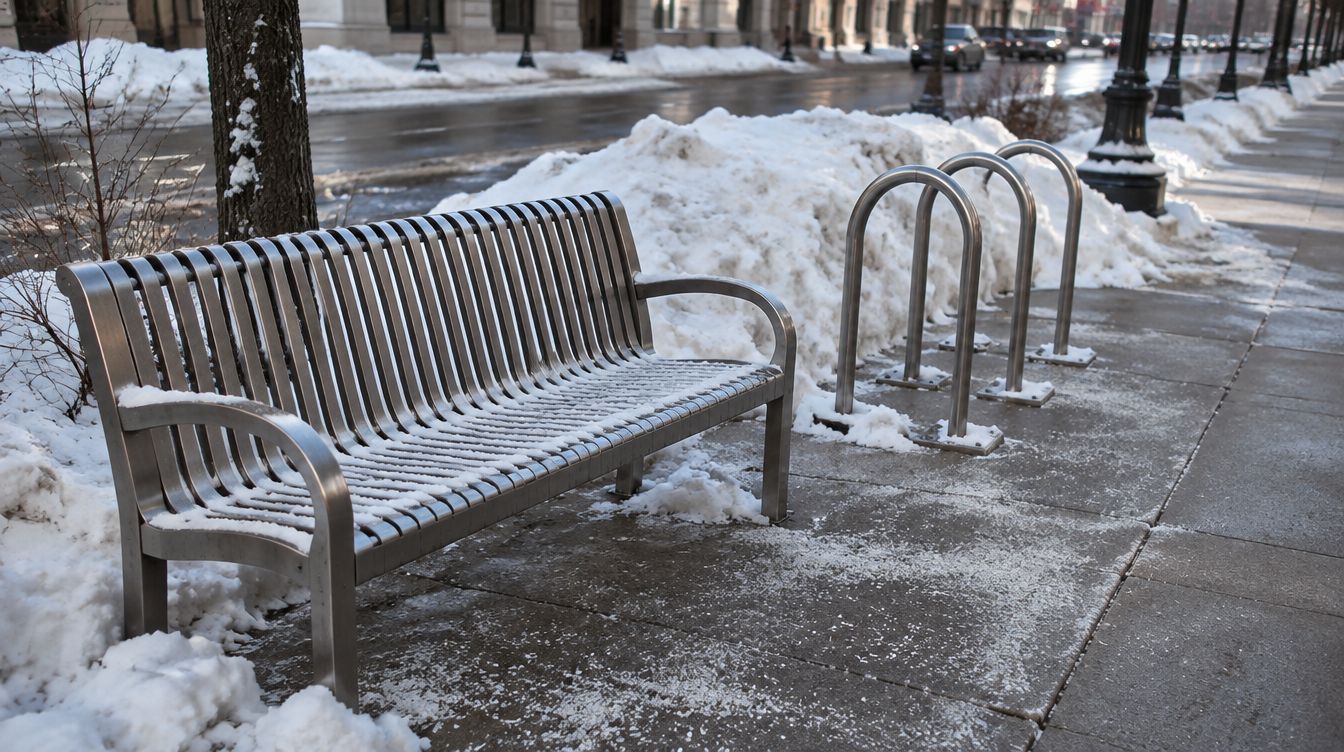
In the northern states and mountain regions, site furniture spends several months a year buried in snow, splashed with brine and brushed by plow blades. Most winter damage is predictable. It happens at the same spots on the same pieces every year. If you choose finishes, details and locations with winter in mind, furniture can come through the season with little more than a spring wash.
How salt attacks furniture
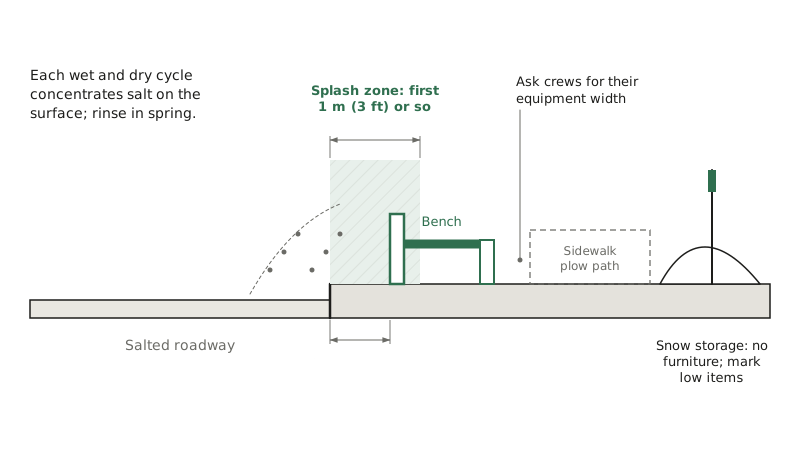
Road salt and liquid de-icers are mostly chloride compounds. Chlorides speed up corrosion of steel and zinc, attack bare concrete and stain stainless steel. The damage is worst where salty slush is thrown up by traffic and then left to dry, because each wet and dry cycle concentrates the salt on the surface.
The highest risk zones on a typical street are:
- The first 3 ft (1 m) or so beside a salted roadway, where splash lands.
- Bus stops and crosswalks, where sidewalks are salted heavily for safety.
- Building entrances and ramps, where maintenance staff spread extra salt.
- Low spots where meltwater pools around bases and anchors.
Calcium chloride and magnesium chloride work at lower temperatures than rock salt but can be harder on concrete. If your site uses them, pay extra attention to concrete footings and pads.
Finishes that hold up
For steel furniture, the most reliable winter finish is hot-dip galvanizing under a powder coat. The powder coat keeps salt off the zinc, and the zinc protects the steel if the powder coat is chipped. A powder coat applied over bare steel, with no zinc underneath, can look identical when new, but once it is chipped, rust creeps under the paint and lifts it.
Other points to check:
- Edges and welds. Paint is thinnest on sharp edges. Rounded edges and ground welds hold coating better.
- Fasteners. Use stainless or properly galvanized hardware. Plain zinc-plated bolts rust in one winter and stain the finish below them.
- Stainless parts. In salted locations, 316 stainless is the safer grade. Even then, rinse it in spring to remove staining.
- Wood. Wood is not harmed by salt the way steel is, but it needs to drain and dry. Raised slats with gaps shed slush.
Details that trap water
Freeze-thaw damage happens when water gets into a space, freezes and expands. On furniture, the usual culprits are:
- Hollow tubes without drainage. Water enters through a gap or a cracked weld, freezes and can split the tube. Tubes should be either fully sealed or given drain holes at the low point.
- Base plates set flat in a puddle. Salty water sits under the plate and attacks the steel and the concrete. A slight fall in the pad away from the base helps, and so does a pad that is not set below the surrounding paving.
- Receptacle bottoms. A closed bottom holds meltwater and slush. Drainage holes keep liners from freezing to the body.
- Planters. Soil that stays saturated can freeze and push against the walls. Good drainage and a liner reduce stress on the planter.
Plows, blowers and snow storage
Mechanical damage often costs more than corrosion. Plow blades and sidewalk machines hit anything they cannot see or cannot get around.
- Keep the plow path clear. Leave enough room between furniture and curbs, walls and other furniture for the sidewalk plow your crews use. Ask them for the width of their equipment before you finalize the layout.
- Set back from the curb. Many street design standards ask for a setback from the curb face so that road plows and opening car doors do not strike furniture. Many cities use something around 24 in (610 mm); confirm the local rule.
- Avoid snow storage areas. Boulevards and corners where crews pile snow are poor places for benches and racks. Furniture there gets buried, pushed and scraped.
- Mark low items. Short bollards, low planters and rail-mounted racks can disappear under a snowbank. Snow stakes or tall markers in late fall prevent hits.
- Use removable pieces where it helps. Removable bollards and surface-mounted seating can be pulled for the winter in places that see heavy snow clearing, then reinstalled in spring.
Keeping bike parking usable
Winter cycling is growing in many cities, and racks that disappear under a windrow push riders to lock to trees and railings. Place at least some racks under cover or near entrances where snow is cleared anyway. Choose rack shapes that leave room for a plow to pass along the row, and include the rack area on the snow clearing map so crews know it is meant to stay open. Rail-mounted racks are easier to move for the season if a location turns out to be a snow storage spot.
A simple winter routine
- Late fall: touch up chips and scratches so bare steel is not exposed over winter. Tighten loose anchors. Install snow markers. Remove or store seasonal items.
- During winter: clear snow away from bases rather than piling it against them. Check for plow strikes after major storms and report damage early.
- Early spring: wash everything with fresh water to remove salt residue, paying attention to bases, undersides and joints. Inspect for chipped coating, cracked welds and lifted anchors, then repair before the next season.
A spring wash is the single most effective step. Salt left on a surface through a warm, damp spring keeps working long after the snow is gone.
Frequently asked questions
Should we bring furniture indoors for the winter?
Usually not. Well-finished steel furniture can stay out all year. Storage makes sense for pieces in snow storage zones, seasonal patio sets and anything with fabric, such as shade canopies that are not rated for snow loads.
Is powder coat alone enough for salted areas?
It can look fine at first, but once chipped, rust spreads under the coating. Galvanizing under the powder coat gives far longer protection where salt is heavy.
Why do concrete pads crumble around our furniture?
De-icers and freeze-thaw cycles break down concrete that is porous or poorly finished. Air-entrained concrete and a penetrating sealer help. Ask your engineer or concrete supplier what suits your climate.