Crash-Rated vs Non-Rated Bollards
A crash rating tells you that a complete bollard system stopped a specific vehicle at a specific speed in a test. Learn how to read ratings, when a site actually needs them, and what non-rated bollards can and cannot do.

Most bollards in parks, plazas and parking lots are not crash rated, and that is fine for what they do. They guide drivers, mark edges and resist low-speed bumps. A crash-rated bollard is a different product. It is part of an engineered system that has been tested to stop a vehicle of a set weight at a set speed. Mixing up the two is one of the most serious mistakes in site design, because people may stand behind a bollard believing it will protect them when it will not.
What a crash rating actually means
A crash rating comes from a full-scale test. A real vehicle of a defined weight is driven into the barrier at a defined speed, and testers measure how far the vehicle, or its cargo bed, travels past the barrier line. The rating describes that result. It applies to the exact design tested, including the post, the spacing, the footing and the installation details.
The most common standards are:
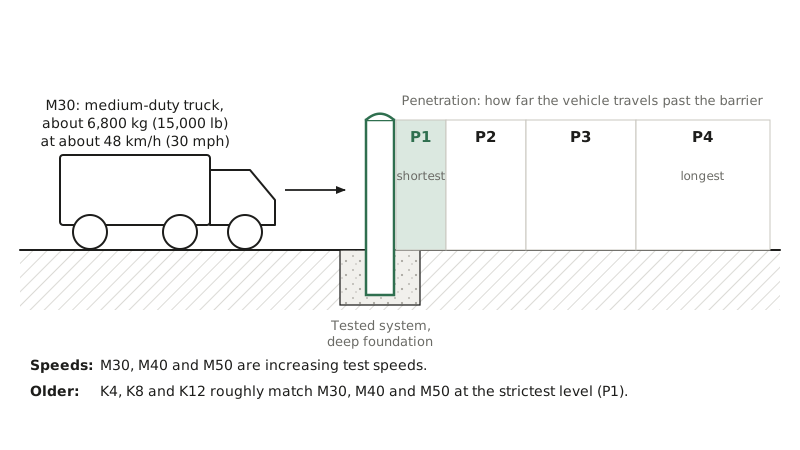
- ASTM F2656, the main North American standard for vehicle crash testing of perimeter barriers. Ratings combine a vehicle type, a speed and a penetration level. For example, an M30 rating means a medium-duty truck of about 6,800 kg (15,000 lb) at about 48 km/h (30 mph). M40 and M50 are higher speeds. Penetration levels, P1 to P4, describe how far the vehicle travelled past the barrier, with P1 the shortest distance.
- Older US Department of State ratings, written as K4, K8 and K12. You will still see these on older products and specifications. They roughly line up with M30, M40 and M50 at the strictest penetration level.
- International standards such as IWA 14-1 and the British PAS 68, which use different vehicle classes and are common on imported products.
- Low-speed tests such as ASTM F3016, aimed at storefront and building protection from cars at lower speeds rather than deliberate attacks.
When reviewing a product, ask for the test report, not just a brochure claim. Check the vehicle, speed and penetration, and confirm the tested foundation matches what you can build on your site.
Why most bollards are not rated
Crash testing is expensive, and a rated system needs a deep, engineered foundation, often with steel reinforcement tying posts together below grade. That adds excavation, cost and conflicts with buried utilities. For most sites, the risk does not justify it.
A non-rated bollard still does useful work:
- It marks clearly where vehicles must not go, which most drivers respect.
- A well-built embedded steel bollard can resist low-speed impacts, such as a car rolling forward while parking.
- It stops casual intrusions like drivers cutting across a plaza or parking on a sidewalk.
What it cannot do is reliably stop a vehicle travelling at road speed. No one should claim otherwise, and a non-rated bollard should never be presented to the public or a client as a security barrier.
When a site needs crash-rated bollards
Consider rated protection when any of these apply:
- The site is a likely target, such as government buildings, courthouses, embassies or critical infrastructure.
- Large crowds gather close to a road with a long, straight approach, such as event plazas, markets and stadium entrances.
- A road ends at or points straight toward a building entrance, patio or play area, and vehicles can build up speed on the approach.
- An insurer, owner policy or government program requires it.
In these cases, bring in a security professional or engineer to assess the approach routes, likely vehicle speeds and the space available behind the barrier. The design speed should come from the real approach on your site, not a guess.
Comparing the two options
| Factor | Non-rated | Crash rated |
|---|---|---|
| Main job | Guidance and low-speed protection | Stopping a defined vehicle at a defined speed |
| Foundation | Simple footing or base plate | Engineered, often deep or linked footings |
| Design input | Supplier and site designer | Engineer or security consultant |
| Cost per position | Lower | Much higher, mostly in foundation and installation |
| Look | Wide range of styles | Limited, though covers can soften the look |
Mistakes to avoid
- Buying a rated post and installing it on a shallow footing. The rating no longer applies. The tested foundation is part of the rating.
- Widening the spacing. A rating assumes the tested spacing. A gap wider than tested may let a vehicle through.
- Leaving gaps at the ends. A line of rated bollards that a vehicle can drive around protects nothing. Tie the ends into buildings, walls or other barriers.
- Calling a decorative bollard "security". Language matters. Describe non-rated products as guidance or delineation.
- Forgetting access. Emergency vehicles still need a way in. Rated removable or operable barriers exist, but plan them early.
Our Fixed Bollard is a non-rated steel bollard for guidance and low-speed protection. If your project needs rated protection, tell us early and we can discuss covers and finishes that work over a rated system specified by your engineer.
Frequently asked questions
Does a rating protect against any vehicle?
No. A rating covers the tested vehicle at the tested speed and angle. A heavier vehicle or a higher speed is outside the rating. That is why the design speed and vehicle should come from a site assessment.
Can a non-rated bollard be upgraded to rated?
Not by adding concrete or a thicker pipe. A rating comes from testing a full system. To get rated protection, you need a tested design installed as tested.
Is a shallow-mount crash-rated bollard available?
Yes, some tested systems use shallow foundations for sites with utilities close to the surface. They usually need a wider footprint and still require an engineer to confirm they suit your site.