Using Bollards for Pedestrian Safety
Bollards protect patios, storefronts, bus stops and play areas from vehicles that leave the road or drive over the curb while parking. This guide covers where they help most, what level of protection to ask for and how to keep the space welcoming.
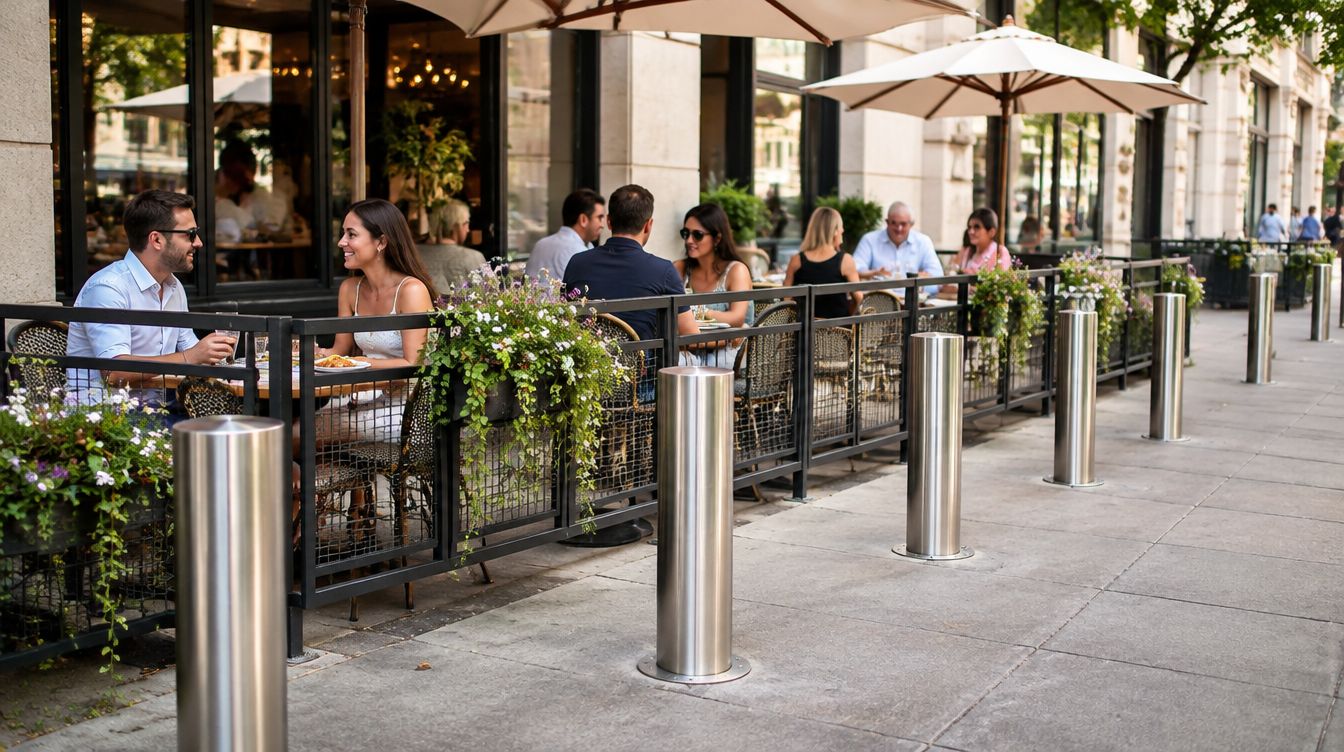
Many vehicle crashes into pedestrian spaces are not dramatic. A driver presses the accelerator instead of the brake while parking nose-in to a storefront. A car mounts a curb at a tight corner. A delivery truck backs into a patio. These low-speed events still injure people, and they happen in predictable places. Bollards are one of the simplest tools to protect those places. The key is to match the bollard to the risk, and to be honest about what it can and cannot stop.
Find the places at risk
Look for spots where people stand or sit close to where vehicles move, especially where a vehicle points toward them. Common examples:
- Parking spaces facing a building. Nose-in stalls that end at a sidewalk, storefront window or entrance are the most common source of building strikes.
- Outdoor patios beside a street or parking lot, especially on the outside of a bend.
- Bus stops and shelters at the curb, where people wait with their backs to traffic.
- Playgrounds, school entrances and daycare yards near drop-off lanes and parking.
- T-intersections where a road ends facing a sidewalk or building.
- Drive-through lanes that run alongside walkways or seating.
Walk the site and imagine a car going straight when it should have turned or stopped. Wherever it would end up among people, consider protection.
Match protection to the risk
Protection should follow the speed and type of vehicle that could reach the space.
- Low speed, parking-lot movement. Embedded steel bollards on proper footings, set in front of storefronts and patios, are the common approach. They resist a car creeping or lurching forward from a parking space. For storefront risk, some owners ask for products tested to a low-speed standard such as ASTM F3016.
- Street traffic at road speed. Ordinary bollards are not designed to stop a car at road speed. If vehicles can approach a crowded space fast and straight, you need an engineered, crash-rated system designed for that speed.
- Guidance only. Where the risk is drivers wandering into a pedestrian area, not crashing, decorative or base-plate bollards can mark the edge and steer drivers away.
Never describe or sign a non-rated bollard as a crash barrier. People make choices about where to sit and stand based on what they think protects them.
Layout that protects without fencing people in
Bollards should keep vehicles out while keeping the space open, comfortable and accessible.
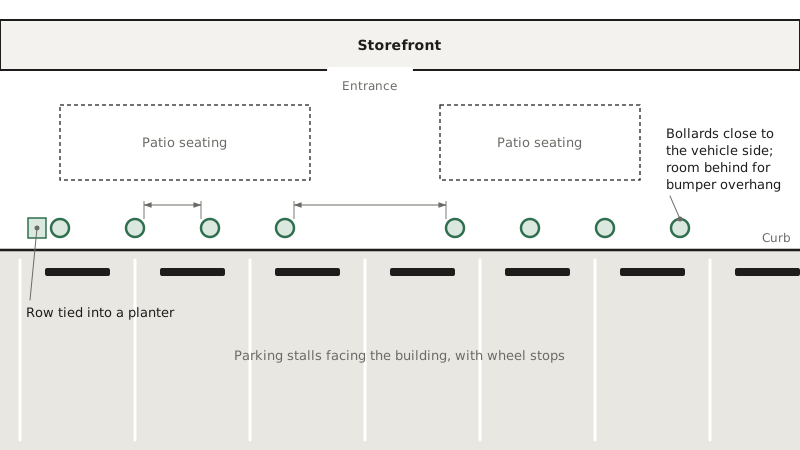
- Put bollards between the vehicle and the people, as close to the vehicle side as possible, so a vehicle stops before it reaches seating or a doorway.
- Leave enough space behind the bollards for a vehicle that pushes a bollard over slightly, or for parts of a vehicle that overhang the bollard, such as the front bumper and hood.
- Keep clear gaps wide enough for wheelchairs and strollers, but narrower than a car. A gap of about 1.2 to 1.5 m (4 to 5 ft) is a common choice.
- Tie the ends into walls, planters or other solid edges so cars cannot drive around the row.
- Do not block entrances or curb ramps. The accessible route must stay clear. Check CSA B651 and provincial accessibility rules, such as Ontario's AODA Design of Public Spaces standard where it applies.
Wheel stops, curbs and bollards together
Bollards work best as one layer among several. Wheel stops in parking stalls cue drivers to stop, but a car can roll over them, so they are not protection on their own. Raised curbs slow a vehicle slightly. Bollards then stop the vehicle before it reaches people. Heavy planters can fill the same role in some places and soften the look. Each layer adds a little, and together they reduce both the chance and the severity of a strike.
Simple design changes help too. Angle parking away from the building, or turn stalls so cars face a landscaped area instead of a window. Narrow driveways and tighter turns lower speeds near people.
Make bollards part of a welcoming space
Protection should not make a patio feel like a checkpoint. A few choices keep it friendly:
- Choose a bollard style and colour that matches the benches, racks and receptacles on the site.
- Combine bollards with planters, bike racks or seating so the edge feels designed rather than defensive.
- Light the row at night so pedestrians and drivers both see it clearly.
- Use contrasting colour bands for visibility rather than bright warning yellow, unless the site calls for it.
Our Fixed Bollard can be finished in any colour, and pairs well with our Linear Planter along patio edges.
Common mistakes
- Bolting bollards to a thin sidewalk slab in front of nose-in parking. The anchors fail before the bumper stops.
- Leaving one gap wide enough for a car, often at the end of the row.
- Protecting the patio but not the entrance door beside it.
- Placing bollards so close to the patio edge that a vehicle's front end still reaches the tables.
- Forgetting that patios change. When seating expands into parking spaces in summer, the protection should move with it.
Frequently asked questions
Who is responsible for bollards in front of a business?
On private property, usually the owner. In a public right-of-way, the municipality controls what can be installed, and a permit is often required. Check with your local authority before planning.
Are planters as good as bollards for protection?
Heavy planters can redirect or slow a vehicle, but unless they are engineered and anchored for it, they may slide. Bollards on footings are more predictable for low-speed impacts.
How far apart should bollards be in front of a storefront?
Close enough that a car cannot fit between them, but wide enough that people can walk through comfortably. Follow your local accessibility rules for the minimum clear width.