Hot-Dip Galvanizing Explained
Hot-dip galvanizing bonds a thick layer of zinc to steel after it is fabricated. Here is how it works, how long it lasts and why it pairs so well with powder coat.
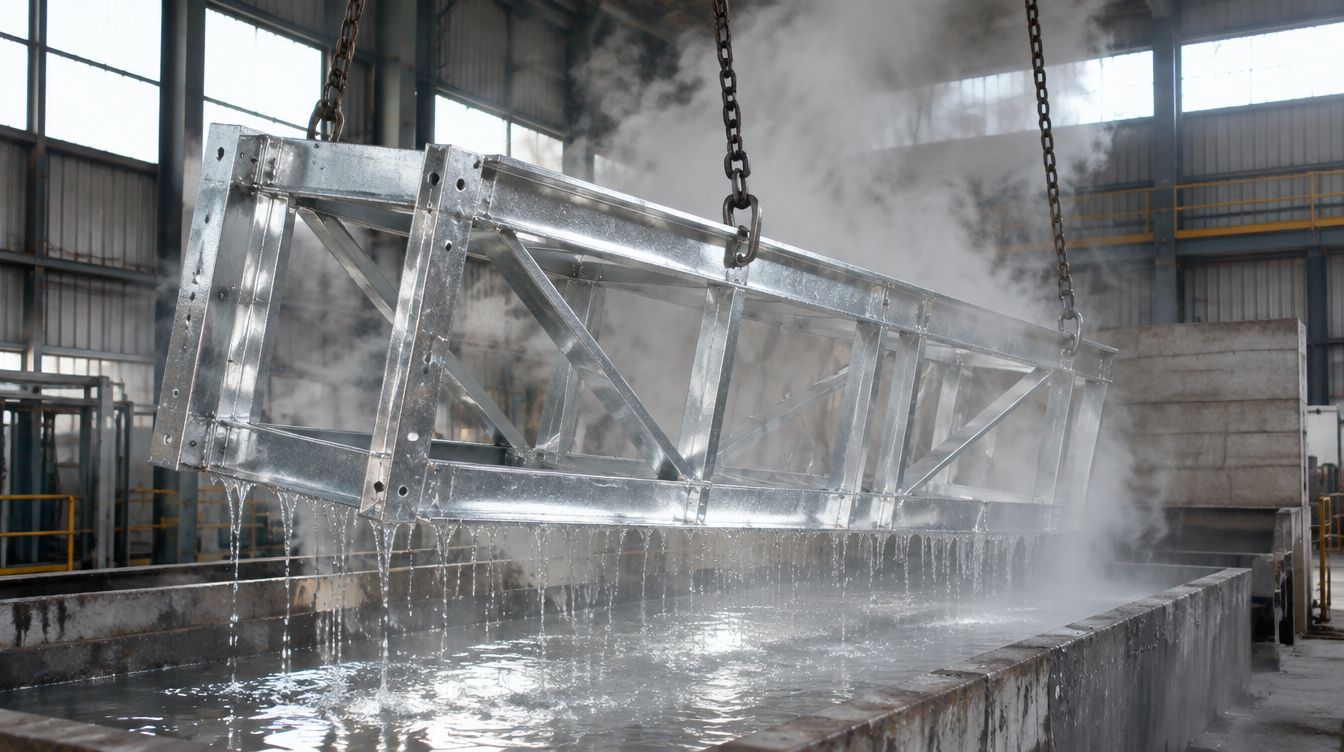
Bare steel left outdoors starts to rust within days. Paint alone slows that down, but once it is scratched, rust creeps underneath and lifts the coating. Hot-dip galvanizing solves the problem at its root: it wraps the steel in zinc that is metallurgically bonded to the surface and keeps protecting even where it is damaged.
For outdoor site furniture such as bike racks, bollards and benches, galvanizing is one of the most cost-effective ways to get decades of service. This guide explains how it works and what to ask for.
How the process works
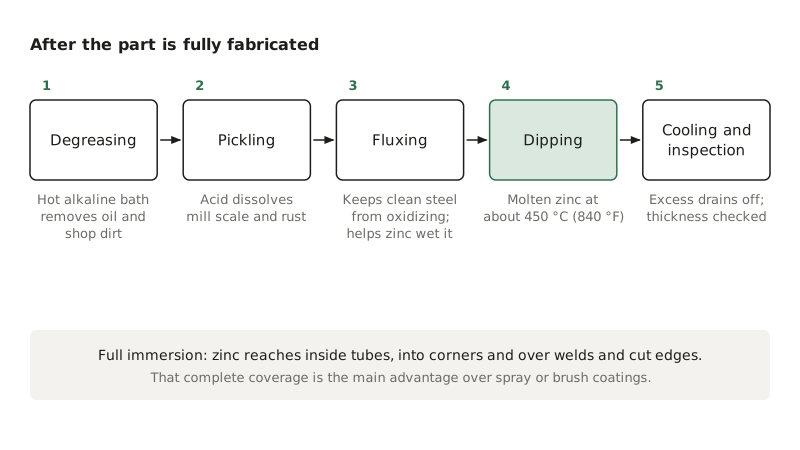
Hot-dip galvanizing is done after the part is fully fabricated, cut and welded. The steps are broadly the same at every galvanizing plant:
- Degreasing. A hot alkaline bath removes oil, grease and shop dirt.
- Pickling. An acid bath dissolves mill scale and rust down to clean steel.
- Fluxing. A flux solution prevents the clean steel from oxidizing before it meets the zinc and helps the zinc wet the surface.
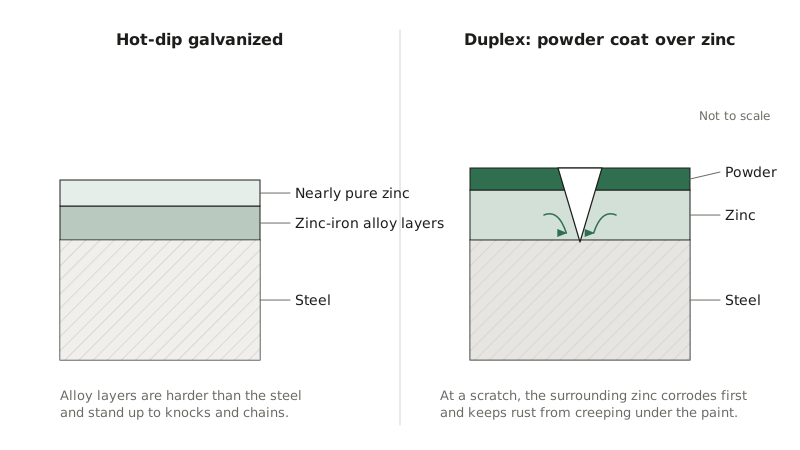
- Dipping. The part is lowered into molten zinc at around 450 °C (840 °F). Zinc reacts with the iron to form a series of zinc-iron alloy layers, topped by a layer of nearly pure zinc.
- Cooling and inspection. The part is withdrawn, excess zinc drains off, and it is cooled, inspected and checked for thickness.
Because the part is fully immersed, zinc reaches inside tubes, into corners and over welds and cut edges. That complete coverage is the main advantage over coatings applied by spray or brush.
Why galvanizing protects so well
Zinc protects steel in two ways:
- Barrier protection. The zinc coating physically separates the steel from moisture and oxygen. Over time it develops a stable surface film, often called the zinc patina, that slows its own corrosion.
- Sacrificial protection. Zinc is more reactive than steel. Where the coating is scratched or chipped, the surrounding zinc corrodes in preference to the exposed steel, protecting small damaged areas from rust.
The alloy layers are also harder than the steel underneath, so a galvanized coating stands up well to the knocks, chains and locks that site furniture takes every day.
How long it lasts
Galvanizing wears away slowly and fairly predictably. Its life is roughly proportional to coating thickness and depends heavily on the environment:
- Rural and suburban air: many decades before first maintenance is typical.
- Urban and industrial areas: shorter, because pollutants speed up zinc corrosion.
- Coastal sites and road salt: shorter again. Chlorides from sea spray and de-icing salt are hard on zinc.
- Buried or constantly wet areas: the base of a post set in soil or in a puddle wears fastest.
In Canada, road salt is often the biggest factor for street furniture, which is why galvanizing under powder coat is common.
Standards and coating thickness
Galvanizing of fabricated steel products is covered by CSA G164 in Canada, with many specifiers also referencing ASTM A123 for products and ASTM A153 for hardware. These standards set minimum coating thickness based on the type and thickness of the steel. Thicker steel generally takes a thicker coating.
Steel chemistry also affects the result. Steels with higher silicon or phosphorus react more with zinc, producing a thicker coating that may look duller and more matte rather than bright and spangled. That appearance is cosmetic. It does not mean the coating is defective, and the thicker coating often lasts longer.
Galvanized versus other zinc coatings
- Pre-galvanized (mill galvanized) steel is coated as sheet or tube before fabrication. The coating is thinner, and cutting and welding leave edges and welds unprotected unless they are touched up.
- Electroplated zinc gives a thin, bright finish suited to indoor fasteners. It is not a durable outdoor coating on its own.
- Zinc-rich paint contains zinc dust and gives some sacrificial protection. It is useful for repairs but is not equivalent to a hot-dip coating.
For outdoor furniture, hot-dip galvanizing after fabrication is the benchmark. Ask suppliers directly which method they use, because "galvanized" on a data sheet can mean any of these.
The duplex system: galvanizing plus powder coat
Galvanizing on its own weathers to a dull, matte metallic finish. That suits many settings, but most site furniture needs colour. The answer is a duplex system: hot-dip galvanizing followed by powder coating.
The two coatings protect each other. The powder coat shields the zinc from the weather, so the zinc is consumed far more slowly. If the paint is damaged, the zinc underneath keeps rust from spreading under the coating. The combined life is generally longer than the two coatings would last separately, which makes it a strong choice for hard-working pieces such as bollards and bike racks.
Powder coating over galvanizing needs care. The zinc surface must be prepared correctly, and the part is often preheated to drive out trapped gases that would otherwise cause pinholes in the finish. Our powder coating guide covers this in more detail.
Design details that matter
- Vent and drain holes. Hollow sections must have holes so the cleaning solutions and molten zinc can flow in and out and air can escape. Sealed hollow parts are dangerous in a zinc bath.
- Kettle size. Very long or large pieces may need to be dipped in stages or fabricated in sections.
- Distortion. Thin, flat plates and asymmetric parts can warp from the heat. Good design and balanced welding reduce this.
- Wet storage stain. Freshly galvanized parts stacked tightly while damp can develop white powdery deposits. Store them ventilated and dry.
Frequently asked questions
How is damaged galvanizing repaired?
Small areas are usually repaired with zinc-rich paint, zinc spray or zinc-based solder, following ASTM A780 practice. Clean the area thoroughly first. Large damaged areas may require the part to be regalvanized.
Can galvanized steel be welded after galvanizing?
It can, but welding burns off the zinc near the weld and produces zinc fumes that need proper ventilation and protection. The weld area must be repaired afterward. It is better to complete all welding before galvanizing.
Why does new galvanizing look different from part to part?
Differences in steel chemistry, thickness and cooling rate change the surface. Some parts are bright and spangled, others are matte and darker. Both are normal, and over time all galvanized surfaces weather to a similar dull finish.