Stainless vs Galvanized Steel Outdoors
Stainless steel and galvanized steel both last for decades outdoors, but they fail in different ways and cost very different amounts. Here is how to pick the right one for each piece and each site.
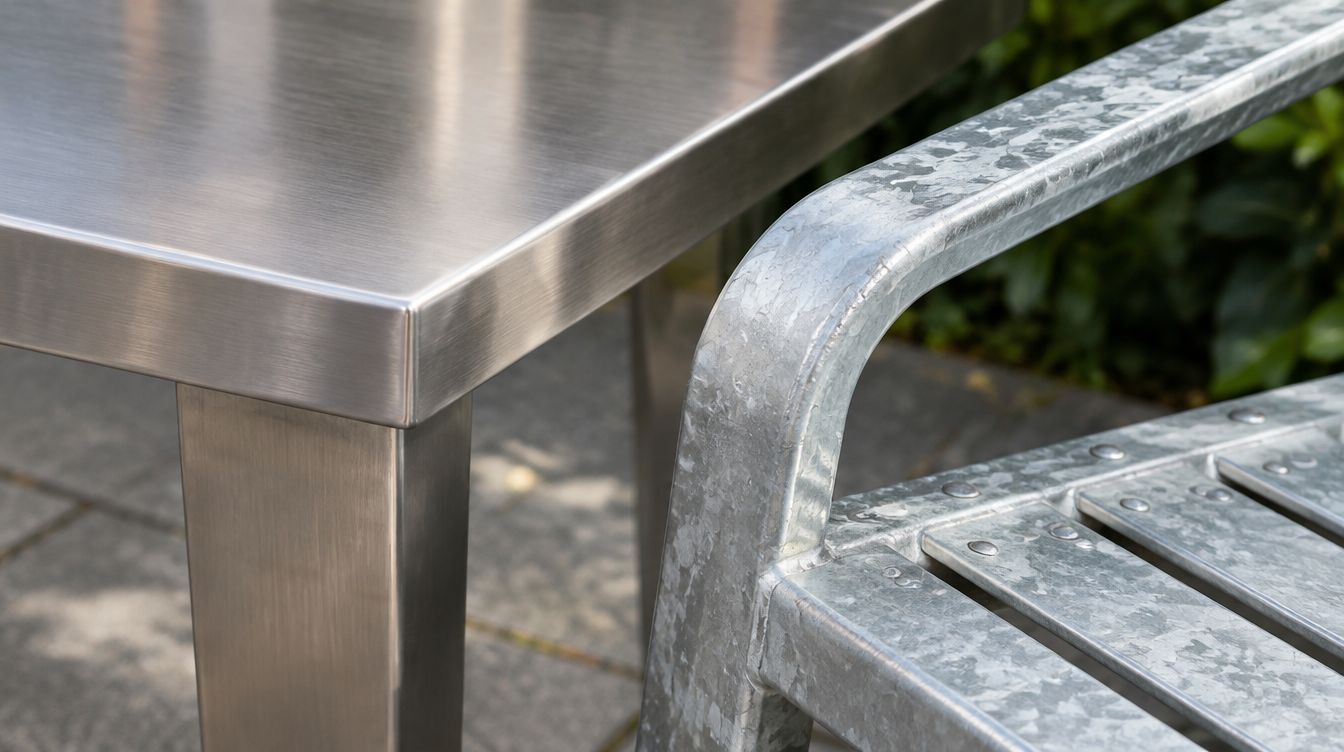
Most outdoor site furniture is made from one of two materials: carbon steel protected by zinc and paint, or stainless steel left bare or brushed. Both can last a very long time. The choice comes down to how the piece will be used, what the air and ground around it contain, what it should look like in ten years, and how much budget you have. This guide explains how each material protects itself, where each one struggles, and how to decide.
How each material resists rust
Galvanized steel is ordinary carbon steel dipped in molten zinc. The zinc bonds to the steel and forms a tough coating. Zinc corrodes far more slowly than bare steel, and it protects the steel sacrificially: if the coating is scratched, the surrounding zinc corrodes first and keeps the exposed steel from rusting. On site furniture, a powder coat usually goes over the zinc. This combination, often called a duplex system, lasts much longer than either layer on its own. In Canada, galvanizing of fabricated steel is commonly specified to CSA G164 or ASTM A123.
Stainless steel contains chromium, which forms a thin, invisible oxide film on the surface. If the film is damaged, it re-forms by itself as long as oxygen reaches the surface. There is no coating to chip off. The protection is the metal itself, all the way through.
The two common grades for outdoor work are:
- 304 stainless: the general-purpose grade. It performs well inland, away from salt spray and heavy de-icing.
- 316 stainless: adds molybdenum, which improves resistance to chlorides. It is the usual choice near the ocean, on salted roadsides and around pools.
Where stainless is worth the cost
Stainless costs much more than galvanized steel, both as raw material and to fabricate, because it is harder to cut, weld and finish cleanly. It earns that premium in a few situations:
- Heavy abrasion. Bike rack tubes take constant contact from frames, locks and chains. A coating wears through over time on busy racks. Bare stainless has nothing to wear off.
- A bare metal look. If the design calls for a natural metal finish rather than a colour, stainless keeps that look without paint.
- Touch points. Handrails, bench arms and bollard tops get handled daily. Stainless stays smooth and does not show worn paint.
- Food and hygiene areas. Stainless is easy to clean and does not have a coating that can crack and trap dirt.
Where galvanized and coated steel is the better buy
For most benches, receptacles, planters and racks, a galvanized and powder coated finish is the practical choice:
- Colour. Powder coat lets you match a brand palette or a municipal standard. Stainless can be painted, but the coating adhesion is harder to get right and you lose the main reason for paying extra.
- Large parts. Planters, receptacle bodies and shade frames use a lot of steel. The cost gap between stainless and galvanized grows with the weight of the piece.
- Easy repair. A chipped powder coat can be touched up on site. Damage on stainless is often harder to hide because brushed grain and polish are difficult to match by hand.
- Proven life. A good duplex finish commonly gives decades of service in normal urban conditions before the zinc layer is under threat.
Stainless is not rust-proof
The most common surprise with stainless is brown staining, often called tea staining. It is usually cosmetic, but it looks like rust and generates complaints. It is caused by chlorides sitting on the surface, especially where rain does not rinse the part. Things that make it worse:
- Using 304 in a coastal or heavily salted location where 316 was needed.
- A rough surface finish. Coarse brushing gives salt and grime more places to hold on. A smoother finish, or electropolishing, resists staining better.
- Contamination during fabrication or installation. Grinding dust or tools used on carbon steel can leave iron particles on stainless, which then rust and stain the surface. Shops that work in stainless keep separate tools for it.
- Crevices. Tight gaps under washers, clamps and base plates hold salty water and are where pitting starts.
Staining can usually be removed with a cleaner made for stainless steel, followed by a fresh water rinse. Regular washing in salted areas prevents most of it.
Mixing the two materials
Stainless and galvanized parts often meet, for example stainless fasteners on a galvanized frame. When two different metals touch in the presence of water, the less noble metal, here zinc, corrodes faster. In practice, small stainless fasteners in a large galvanized part are generally acceptable, because the large zinc area spreads the effect. The reverse, galvanized bolts holding stainless parts, is a poor idea: the small zinc-coated bolts will corrode quickly. Where large stainless and galvanized parts meet, isolating washers or sleeves help.
Quick comparison
| Factor | Galvanized + powder coat | Stainless (304 / 316) |
|---|---|---|
| Upfront cost | Lower | Higher, rising with part size |
| Colour options | Wide range | Natural metal, typically |
| Abrasion on contact points | Coating wears over time | Excellent |
| Salt and coastal sites | Good with intact coating | Good with 316 and a smooth finish |
| Field repair | Touch-up paint | Clean and refinish, harder to blend |
A practical way to decide
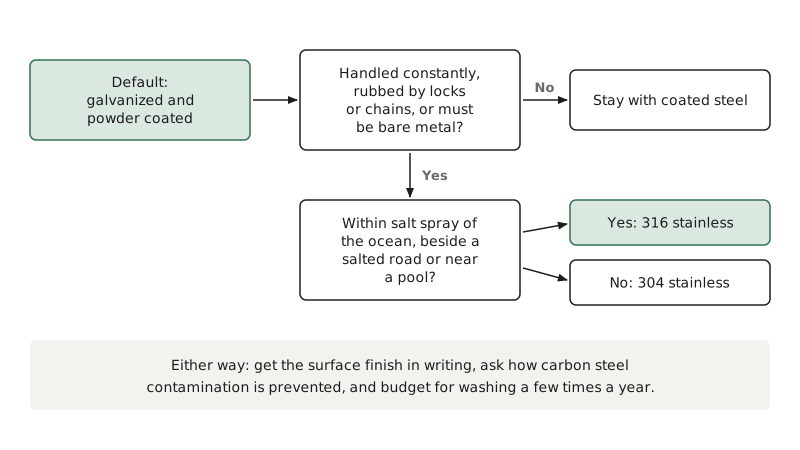
- Start with galvanized and powder coated steel as the default for each item.
- Switch to stainless for parts that are handled constantly or rubbed by locks and chains, or where the design needs bare metal.
- If you choose stainless and the site is within salt spray of the ocean, beside a salted road or near a pool, specify 316.
- Ask for the surface finish in writing, and ask how the shop prevents carbon steel contamination.
- Budget for washing. Both materials last longer when salt and grime are rinsed off a few times a year.
Hybrid designs are common and sensible. A bike rack can be made fully in stainless for a high-traffic transit site, while the benches and receptacles nearby stay in a coated finish that matches the street palette.
Frequently asked questions
Does stainless steel need any maintenance?
Yes, but not much. Rinse it with fresh water a few times a year, more often in salted or coastal locations, and clean off any staining with a stainless cleaner before it builds up. Avoid steel wool, which leaves carbon steel particles behind.
Can galvanized steel be left without paint?
It can. Bare galvanizing weathers to a dull matte finish and protects the steel well. Most site furniture is powder coated over the zinc for colour and for extra life, since the paint shields the zinc from the weather.
Is 316 always better than 304?
It resists chlorides better, so it is the safer choice in salty conditions. Inland and away from de-icing salt, 304 usually performs well and costs less. Surface finish and cleaning matter as much as grade.