Planning Shade Structures
A shade structure only helps if its shadow lands where people are at the hours they use the space. Start with the sun, then pick the size and type.
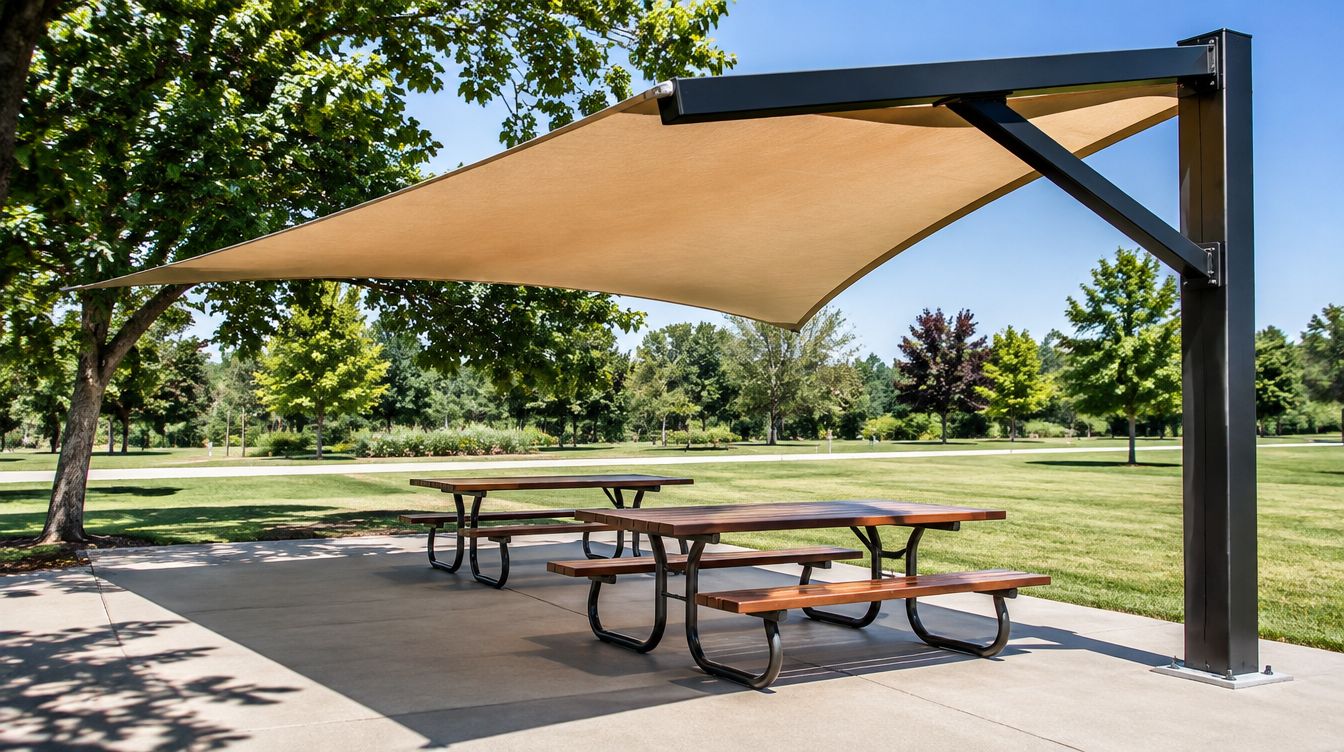
Shade turns a space people avoid on hot afternoons into one they seek out. Benches, picnic areas, play equipment, spectator seating and transit waits all get more use when they are shaded. But shade structures are a significant investment, and it is easy to build one that shades bare pavement while people sit in the sun beside it.
Good shade planning comes down to three questions: when will people use the space, where will the shadow fall at those times, and what kind of structure will cast that shadow and survive the local climate?
Start with how the space is used
Write down who uses the area, at what times of day and in which months. A schoolyard is busiest from late morning to mid afternoon on weekdays. A sports field fills on summer evenings. A cafe patio peaks at lunch and dinner. Each needs shade in a different place.
- List the activities to shade: seating, play equipment, tables, queues, bleachers, waiting areas.
- Note the peak hours and months for each activity.
- Identify existing shade from trees and buildings, and how it moves through the day.
- Mark fixed elements such as paths, utilities, sightlines and emergency access.
Follow the sun
In Canada the sun is always to the south at midday. It rises in the east and sets in the west, and in summer it rises and sets well north of due east and west. That has several practical effects:
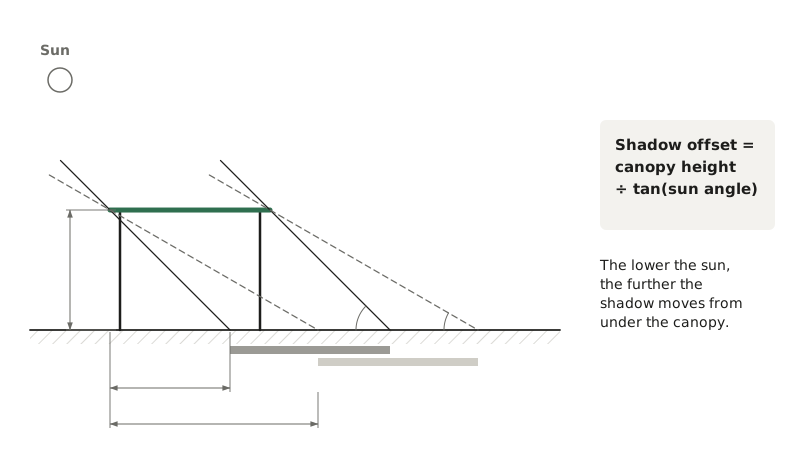
- The shadow is not under the canopy. Except around midday, a canopy's shadow is offset away from the sun. The higher the canopy and the lower the sun, the bigger the offset.
- Afternoon sun is the hard part. The hottest part of the day is usually mid to late afternoon, when the sun is in the southwest and west. Shade for afternoon use needs to extend on the west side of the area being shaded.
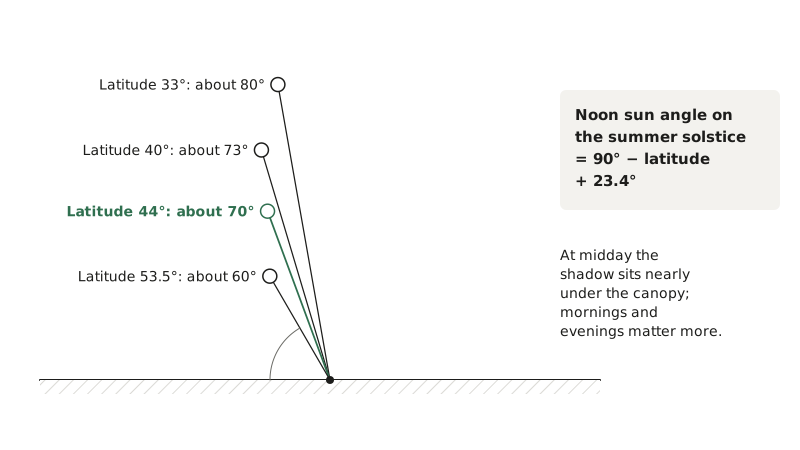
- Midday summer sun is high. At solar noon on the summer solstice, the sun's angle above the horizon is roughly 90 degrees minus your latitude plus 23.4 degrees. That is about 70 degrees in Toronto and about 60 degrees in Edmonton. At midday, the shadow sits nearly under the canopy.
A simple way to estimate the offset: divide the canopy height by the tangent of the sun's angle. When the sun is 45 degrees up, a canopy 3 m (10 ft) high casts its shadow about 3 m (10 ft) away from directly underneath. When the sun drops to 30 degrees, the offset grows to about 5.2 m (17 ft). Free sun path tools and most landscape design software can model this for your exact site.
Sizing and height
A shade structure should cover the activity with some margin on the side the sun will come from during peak use. Some practical guidelines:
- Lower is more effective, higher feels better. A lower canopy gives a larger, more stable shadow. A higher one feels more open and lets heat escape. Many park structures set the low edge around 2.4 to 3 m (8 to 10 ft).
- Clear access routes. If maintenance or emergency vehicles must pass under the structure, set the clearance for them, not for people.
- Picnic and seating areas. Allow for the furniture plus space around it to pull out seats and move through. A single picnic table with circulation needs a much larger footprint than the table itself.
- Add side shade for low sun. For late afternoon use, a vertical screen, a hedge or trees on the west side often do more than a bigger roof.
Choosing a structure type
| Type | Best for | Trade-offs |
|---|---|---|
| Cantilever | Seating, bleachers, play areas where posts would get in the way | Large footings because of the overturning load |
| Single-post umbrella | Individual tables, small seating nodes | Small shade footprint; shadow moves off the table as the sun lowers |
| Four-post hip or pyramid | Picnic areas, play structures, general use | Posts in the space; efficient and economical |
| Shade sails | Overlapping shade with a sculptural look | Many anchor points; fabric tension and snow need attention |
| Solid roof pavilion | Rain shelter, year-round use, group gatherings | Higher cost; must be designed for full snow load in cold regions |
A cantilever shade keeps posts out of the shaded area entirely, which is useful for seating along a path or a play zone where posts would be a hazard. Fabric canopies cast softer shade and let hot air escape. Solid roofs give rain protection and work through winter but cost more and need heavier structure.
Climate and the rest of the year
Shade structures have to survive the whole year, not just July.
- Wind. Open shade structures catch wind like sails. Exposed sites such as hilltops, open fields and waterfronts need careful engineering.
- Snow. In most of Canada, fabric canopies are typically designed to have the fabric removed before snowfall. Solid roofs must carry the full design snow load for the location.
- Winter sun. In cold climates, people welcome sun on a winter bench. Removable fabric lets the space warm up in the shoulder seasons.
- Corrosion. Near salted roads or the coast, galvanized and powder-coated steel holds up far better than painted steel.
From plan to installation
- Map use, sun and existing shade, and pick the structure type.
- Locate underground utilities before choosing post locations.
- Get a geotechnical or soil report if the site has unknown or poor soils.
- Have a licensed professional engineer design the footings and confirm the structure for local wind and snow loads.
- Apply for a building permit where required.
- Schedule fabrication, footing installation, inspection and erection.
Engineering and permits often take longer than fabrication, so start them early. Our guide to shade structure engineering and permits covers that stage in detail.
Frequently asked questions
Are trees a better option than a shade structure?
Trees cool the air through transpiration as well as shading, and they get better with age. But they take many years to grow, need soil volume and care, and cannot always be planted over utilities or on hard surfaces. Many projects use a structure now and plant trees for the long term.
Which direction should a cantilever face?
Generally the canopy should extend toward the sun during peak use, with the posts on the opposite side. For afternoon use, that usually means posts on the east or northeast side and the canopy reaching toward the southwest.
How much does fabric colour affect the shade?
Colour changes how much light and UV pass through and how the space feels underneath. Darker fabrics usually block more light, while lighter fabrics feel brighter. Check the manufacturer's rated UV block for each colour rather than assuming all colours perform the same.