Receptacle Capacity and Service Frequency
A simple method for sizing public waste receptacles and setting pickup schedules from real fill data, so bins stop overflowing without crews emptying half-full liners.

Overflowing bins are one of the most visible signs of a poorly run public space. Litter spills onto the ground, animals get in and people stop bothering to use the bin at all. The opposite problem is quieter but costs more: crews driving a route every day to empty liners that are a quarter full. Both come from the same cause, a mismatch between how fast a receptacle fills and how often it is serviced. Fixing it takes a few weeks of simple data and a willingness to treat each location on its own terms.
Why capacity and frequency go together
Capacity on its own means little. A 120 L (32 US gal) receptacle emptied twice a day handles more waste than a much larger one emptied twice a week. What matters is whether the bin has room left when people arrive with litter, right up to the moment a crew empties it.
Labour and vehicle time are usually the largest cost of a public waste program over the life of a receptacle, typically well above the price of the bin itself. A slightly larger receptacle that removes one service visit a week often pays for itself. Equally, oversizing a bin in a quiet location just adds weight and wasted liners.
Step 1: Gather fill data
You do not need sensors to start. Ask crews to record the fill level of each receptacle every time they service it, for two to four weeks, using simple categories:
- empty or nearly empty;
- about a quarter full;
- about half full;
- about three-quarters full;
- full;
- overflowing, with litter on top or around the bin.
Record the day, time and any special conditions: a heat wave, an event, a holiday, a nearby food truck. A shared spreadsheet or a short form on a phone is enough. If the program covers many bins, start with the ones that get the most complaints and a sample of typical ones.
Step 2: Find the fill rate
From the records, estimate how much each bin fills per day, or per service interval, for each type of day. Weekdays and weekends often differ sharply. So do summer and winter.
A worked example, using made-up figures to show the method:
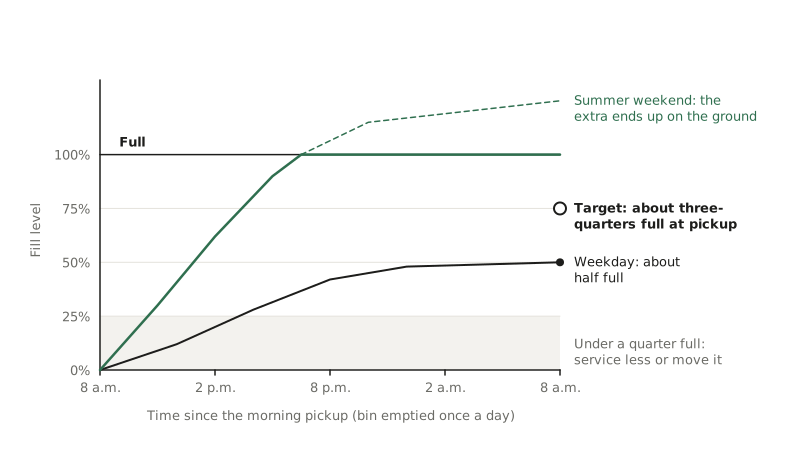
- A 120 L bin beside a park playground is emptied once a day at 8 a.m.
- On weekdays crews find it about half full. That is a fill rate of around half a bin per day.
- On summer weekends crews find it overflowing every morning. The true fill rate is more than one full bin per day, and the extra is ending up on the ground.
Overflowing readings hide the real demand, since you cannot measure litter that went elsewhere. Treat any location that overflows regularly as needing more capacity than the records suggest, make a generous change, and recheck after a few weeks.
Step 3: Set a target and choose a fix
A practical target is for a bin to be about three-quarters full at the scheduled pickup on a normal busy day. That leaves a buffer for unusual days without paying for empty space.
When a bin misses the target, there are four basic levers:
- Service more often at peak times. Good for short, predictable peaks such as summer weekends or lunch hours.
- Use a larger receptacle. Good where waste is steady and bulky, and crews can handle heavier bags safely.
- Add a second receptacle nearby. Often better than one huge bin, since it spreads waste across two lighter bags and gives people a closer option.
- Change what goes in. A recycling station beside the bin takes bottles and cans out of the landfill stream, freeing space.
Where bins are consistently under a quarter full at pickup, reduce frequency, downsize at the next replacement or move the receptacle somewhere it is needed.
Plan for peaks and seasons
- Events: markets, festivals and games generate several times normal waste. Plan temporary bins and extra pickups rather than sizing permanent bins for event days.
- Seasons: beaches and parks may need daily or twice-daily service in summer and much less in winter. Build a seasonal schedule, not one for the whole year.
- Weather: rain adds weight if lids let water in. Covered tops make a large difference to bag weight.
- Nearby businesses: a new takeout restaurant can change a bin's fill rate overnight. Recheck data when the neighbourhood changes.
Keep bags safe to lift
Capacity is limited by what a person can lift as much as by volume. A large liner full of wet food waste or drink containers with liquid left in them can be heavy enough to injure a worker. Check your organization's lifting guidance, and:
- choose receptacles with side doors so liners slide out at ground level;
- avoid oversizing bins where waste is dense or wet;
- use covered tops to keep rain out;
- provide carts or lifting aids on routes with many large bins.
Receptacles like our Slat Receptacle are available with side access for this reason.
Sensors and compacting bins
Fill-level sensors report how full each bin is, so crews can skip bins that do not need service and target the ones that do. Compacting receptacles squeeze waste to hold more between pickups. Both can reduce visits on large or spread-out routes. They also add purchase cost, power or battery needs, software and maintenance. They pay off best where routes are long and fill rates vary a lot. On a compact site with predictable use, simple manual records and a well-tuned schedule often achieve most of the same benefit.
Frequently asked questions
How often should public waste bins be emptied?
As often as needed to keep them below full at every pickup, which varies by location. Busy downtown streets and beaches in summer may need service more than once a day. Quiet paths may need it only a few times a week.
Is one big bin better than two small ones?
Often not. Two smaller bins spread the load, keep bags lighter and give people a closer option. One large bin can work in a compact spot with steady use and good crew access.
How often should we recheck our service schedule?
Review fill data at least each season, and again after any change nearby such as new businesses, events or a layout change. Our guide to receptacle placement covers when moving a bin is a better fix than resizing it.