Where to Place Waste Receptacles
Litter ends up on the ground when a bin is not where people finish their snack or drink. This guide covers where to put receptacles, how far apart, and how to keep them out of the walking path and within reach of collection crews.
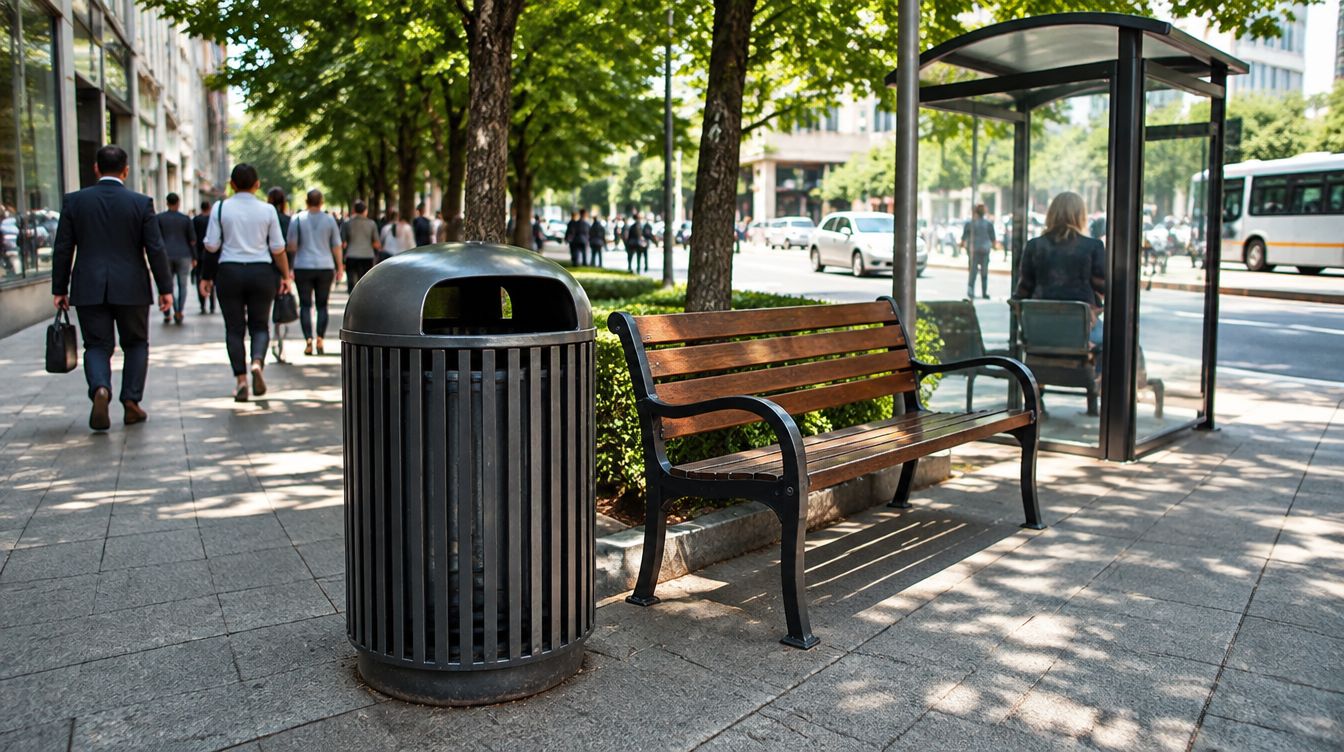
People do not go looking for a bin. They use the one in front of them at the moment they are done with something. That simple fact drives every good placement decision. Put receptacles where people finish eating, drinking, smoking or reading, make them easy to see, and keep them out of the way of everyone walking past. Then check that a crew can reach them without a struggle, or they will not be emptied on time.
Start with where litter is created
Before marking bins on a plan, walk the site and look at where litter already collects. Litter is a map of unmet demand. Common hot spots include:
- Building and store entrances, where people finish a drink or snack before going inside.
- Transit stops, where riders drop cups, tickets and wrappers before boarding.
- Seating areas and picnic spots, where people eat.
- Food trucks, cafes and takeout counters, especially along the route people walk after buying.
- Park and trail entrances and exits, where people leave with what they brought in.
- Parking lot exits and pedestrian crossings, where people pause and clear out pockets or cars.
- Smoking areas, which need a dedicated ash receptacle, not just a waste bin.
Spacing guidelines by setting
There is no single correct distance between bins. It depends on how busy the space is and how often bins are serviced. The ranges below are common starting points that municipalities and campus planners adjust based on what they see.
| Setting | Typical approach |
|---|---|
| Busy downtown sidewalk | One at each corner, plus mid-block on long blocks |
| Local main street | At corners and near cafes, transit and seating |
| Park pathways | At entrances, junctions, seating clusters and play areas, rather than evenly along the path |
| Transit stop | One per stop, near the boarding area, more at busy stations |
| Building entrance | One per main entrance, set slightly to the side |
Clustering beats even spacing. A bin at a path junction serves several routes. A bin halfway along an empty stretch rarely fills and costs as much to service as a busy one.
Keep the walking path clear
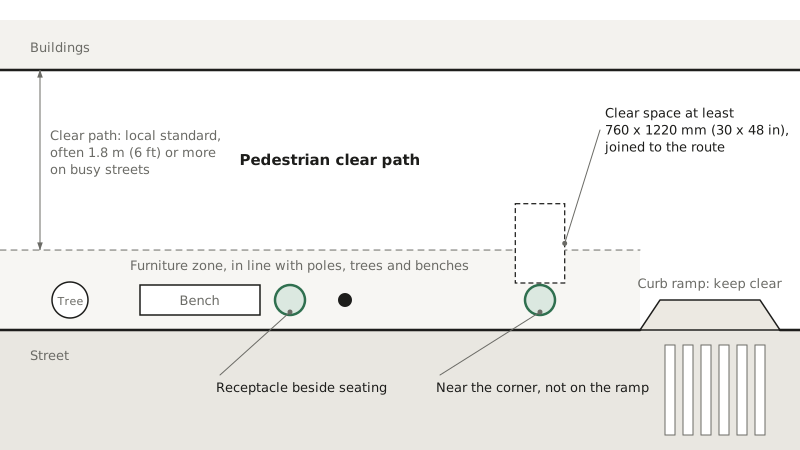
A receptacle in the wrong spot is an obstacle. It narrows sidewalks, blocks curb ramps and creates hazards for people who are blind or have low vision. Place bins in the furniture zone of a sidewalk, the strip between the walking path and the curb, alongside light poles, trees and benches.
- Keep the pedestrian clear path at the width your municipality requires. Many Canadian cities aim for 1.8 m (6 ft) or more of clear sidewalk on busy streets, while CSA B651 sets minimum clear widths for accessible routes. Confirm the local standard.
- Never place bins on a curb ramp, its landing, or in the path to a crosswalk button.
- Keep bins clear of doors, hydrants, loading zones and bus doors.
- Line bins up with other furniture so the edge of the walking path stays straight and predictable for cane users.
- Pick a body colour that contrasts with the paving so the bin is easy to see.
Make bins easy for everyone to use
A bin is only accessible if a person using a wheelchair can get close to it and reach the opening. Provide a clear, level space beside or in front of the bin, at least 760 x 1220 mm (30 x 48 in), connected to the accessible route. Keep the opening and any lid or pedal at a height people can reach. CSA B651 and provincial rules such as Ontario's AODA Design of Public Spaces standard address reach ranges and operable parts, so check which requirements apply to your project.
Avoid foot pedals as the only way to open a lid, and avoid lids that need a tight grip or twisting. A hooded opening that needs no hands to open is the easiest option.
Pair waste with recycling
If you offer recycling, put it right beside a waste bin. A recycling bin standing alone becomes a waste bin, and contamination makes the whole load hard to recycle. Likewise, a waste bin with no recycling nearby collects bottles and cans. Combined stations such as our Stream 3 Recycling Station keep the streams together and use the same signage at every location, which helps people sort correctly.
Plan for collection crews
A well placed bin that is hard to service will overflow. Talk to the people who empty bins before you finalize the plan.
- Confirm how crews travel the route: on foot with a cart, in a small utility vehicle, or by truck from the curb.
- Keep a smooth, firm surface between the bin and the vehicle. Gravel and turf make carts hard to push.
- Leave room to open the service door or lift the lid fully. Bins jammed against walls or benches are hard to empty.
- Avoid locations that collect snow from plows, or that are blocked by snow storage in winter.
- Number each bin on the plan so crews can report problems and track fill levels by location.
Placement mistakes that create litter
- Bins right beside benches. People do not want to sit next to smells and wasps. Set the bin a few metres away, still in clear view.
- Bins directly at door openings. Smells drift inside and the bin blocks traffic. Offset it to one side of the entrance.
- Too few bins at event spaces. Plan for peak days, or add temporary bins when events are on.
- Hidden bins. A bin behind a planter or around a corner might as well not exist.
- Never moving bins. After a season, review fill levels. Move bins from quiet spots to busy ones.
For a first draft, mark bins on your site plan and send it to us through the contact form. We can suggest models and quantities for the space.
Frequently asked questions
How many receptacles does a park need?
Start with one at each entrance, each play area, each picnic or seating cluster and each major path junction. Then track how full each one gets between pickups and adjust. Some will need a larger size or a second bin, while others can be removed.
Should bins be fixed in place?
Yes, in most public spaces. Anchoring stops tipping, theft and drift into the walking path. Use surface anchors into a concrete pad, or an embedded mount where you want a clean look.
Where should ash receptacles go?
Put them at the edge of a designated smoking area, away from entrances and air intakes, and follow any local rules on distance from doors and windows. Keep them separate from waste bins to reduce fire risk.