Where to Place Benches in Public Spaces
A bench in the wrong spot sits empty. Use these rules on microclimate, views, rest intervals and clearances to put seating where people will actually sit.
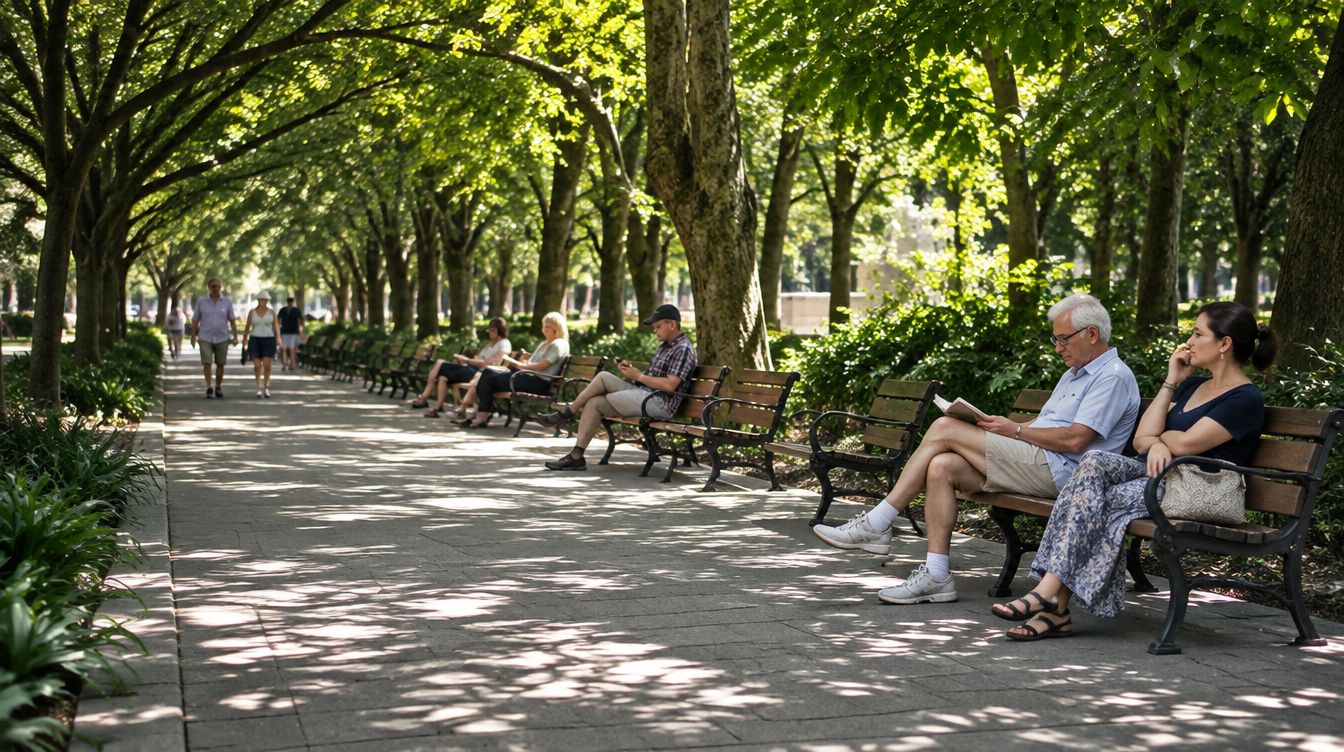
Everyone has seen a bench nobody uses: facing a blank wall, baking in full sun, stuck beside a loud road or placed where sitting feels exposed. The bench itself is rarely the problem. Location decides whether seating gets used, and most of the factors that matter can be checked on a site visit with a sketch plan and a bit of patience.
Start by watching the site
Before drawing anything, spend time on site at different times of day. Note where people already pause: where they lean on railings, sit on steps or wait near a door. Those informal resting spots are strong evidence of where seating is needed. Also note where people walk, including desire lines worn across grass, so you do not put a bench in someone's path.
Questions to answer on each visit:
- Where does the sun fall in the morning, at midday and late in the afternoon?
- Where does the wind funnel, especially between buildings?
- Where is it noisy, and where is it calm?
- What do people look at, and what do they avoid looking at?
- Where do people wait, and for how long?
Sun, shade and shelter
Microclimate is the biggest single factor in whether seating gets used. People want sun in spring, fall and winter, and shade in summer. The best sites offer both within a short walk.
- Provide a mix. Put some benches in open sun and others under trees, building overhangs or a shade structure.
- Think about deciduous trees. They give summer shade and winter sun, which suits most Canadian and northern US climates well.
- Check afternoon sun in summer. West-facing seating in full sun on a hot afternoon will be empty, and dark steel seats can get uncomfortably hot.
- Avoid wind tunnels. Gaps between tall buildings and exposed waterfront edges can be unpleasant most of the year. A low wall, hedge or planter on the windward side helps.
Views, backs and a sense of safety
People tend to prefer seats that give them something to look at and something solid behind them. A bench backed by a planting bed, low wall or building edge, facing out over activity, feels more comfortable than one floating in the middle of a paved area.
- Face benches toward the action: a playground, a fountain, a street with shops, water or a garden.
- Do not face benches directly into oncoming pedestrian traffic. People feel watched.
- Keep sightlines open from surrounding paths so seated people can see and be seen. Hidden corners feel unsafe and can attract misuse.
- Place seating within reach of evening lighting if the space is used after dark.
Rest intervals along routes
For older adults and people with limited mobility, the distance between seats can decide whether a walk is possible at all. Many inclusive design guides suggest seating at intervals of roughly 165 to 330 ft (50 to 100 m) along main pedestrian routes, with closer spacing on slopes. Requirements differ by jurisdiction and type of route, and federal outdoor recreation guidelines address benches on trails and in outdoor developed areas on federal land, so confirm what applies locally.
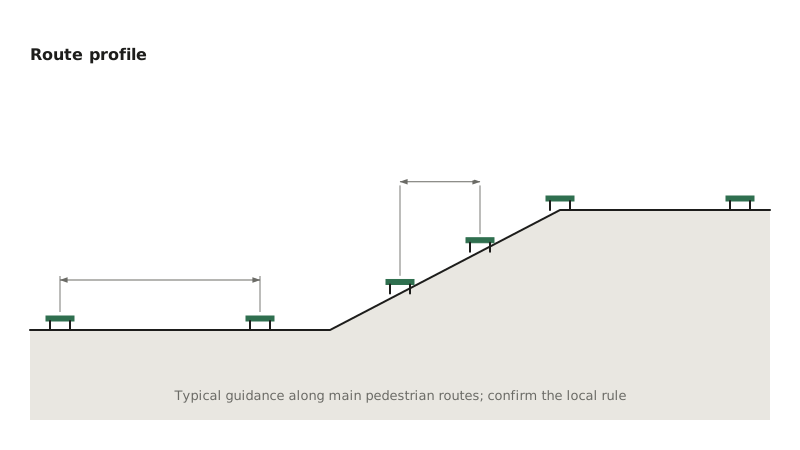
Good places for a rest seat:
- at the top and bottom of long ramps, slopes and stairs;
- near building entrances, transit stops and pickup points;
- at path junctions, where people stop to orient themselves;
- outside restrooms, clinics, pharmacies and grocery stores.
Clearances from paths, curbs and other furniture
A bench must not narrow the walking route. Set it beside the path rather than in it, and allow room in front of the seat for knees and feet so legs do not stick into the clear width. A depth of around 24 in (610 mm) in front of the seat edge, outside the path, is a practical minimum.
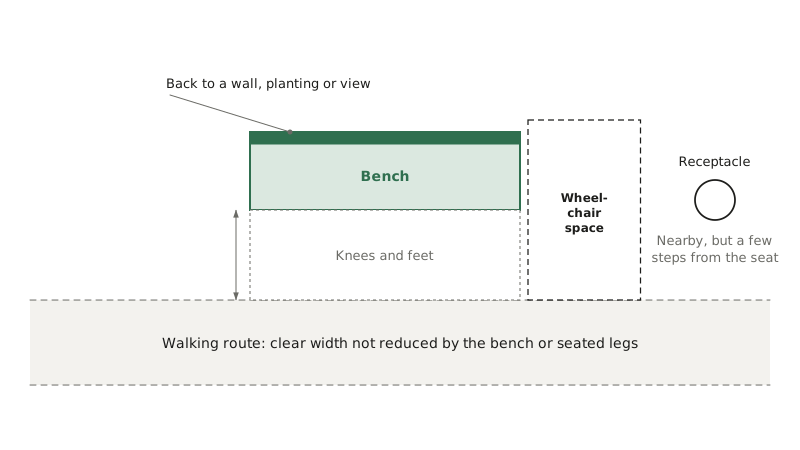
| Near | Guidance |
|---|---|
| Walking route | Keep the full clear width free of the bench and seated legs |
| Street curb | Set well back from the curb, and face away from or parallel to traffic |
| Waste receptacles | Nearby so litter goes in the bin, but a few meters away to keep smells and wasps off the seat |
| Doors and entrances | Close for convenience, but never in the door swing or approach path |
| Wheelchair space | Leave a level clear space beside at least one end |
Clearances for curbs, hydrants, utility covers and transit stops are often set by the municipality or transit agency. Check their standards before finalizing positions.
Groupings and social seating
A single straight bench works for one or two people. For groups, arrange seats so people can see each other:
- two benches at right angles form a corner that suits conversation;
- benches facing each other across a small table or planter suit lunch spots;
- movable seating, such as a cafe set, lets people make their own arrangements where the space is supervised.
Mix grouped seating with a few solitary seats. Not everyone wants company.
Maintenance and seasons
- Leave room around benches for mowers, sweepers and snow clearing equipment.
- Do not place benches in snow storage areas, where plows will damage them.
- Put benches on a firm pad, not on turf, so the ground around them does not wear into a mud patch.
- Avoid low spots where water pools after rain.
Frequently asked questions
Which direction should a park bench face?
Toward something worth looking at, with its back to something solid where possible. In hot climates, avoid west-facing seats in full sun. In cooler climates, south-facing seats are popular in spring and fall.
How far should a bench be from a waste receptacle?
Close enough that people use the bin, often within sight of the seat, but not right beside it. A few meters usually balances convenience against smell and insects.
Should benches be fixed or freestanding?
In public spaces, fixed benches are standard because they stay where you put them and resist theft. Freestanding seating works in supervised spaces such as patios and courtyards where flexibility is the goal.