Bike Parking at Transit Stops
Good bike parking at bus stops and stations extends the reach of transit. Here is how to match parking to the stop, keep boarding areas clear and plan for all-day parkers.
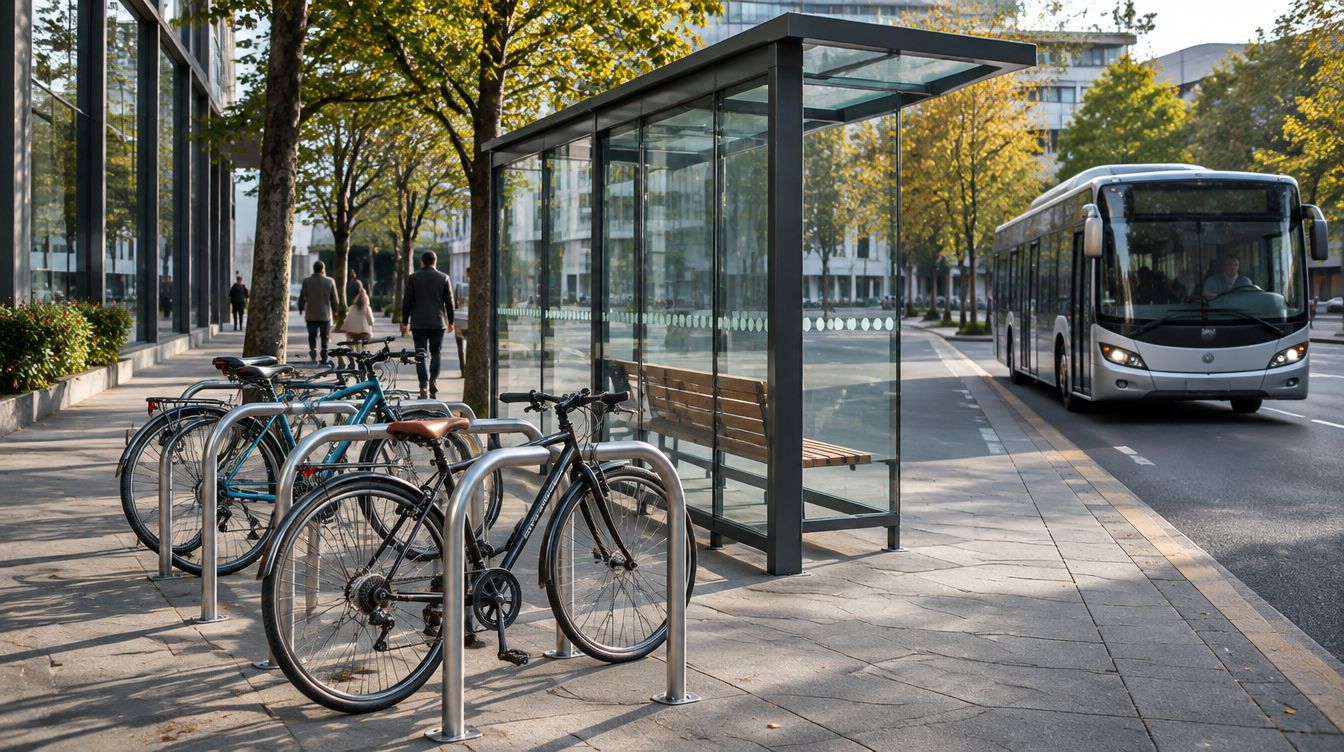
A bike can turn a stop that is too far to walk to into a stop that is a few minutes away. That makes bike parking one of the cheapest ways for a transit agency or municipality to grow ridership. But transit stops are demanding sites. Space is tight, boarding areas must stay clear, and many riders leave bikes all day in a public place. This guide covers how to plan bike parking at everything from a simple bus stop to a busy rail station.
Match the parking to the stop
Not every stop needs the same thing. A useful way to think about it is in three tiers:
| Stop type | Typical parking | Notes |
|---|---|---|
| Local bus stop | A rack or two, if space allows | Many riders bring bikes on the bus rack instead |
| Busy bus stop or rapid transit stop | A small group of racks, ideally covered | Mix of short visits and all-day parking |
| Rail or major transit station | Racks plus secure long-term parking | Bike rooms, cages or lockers, possibly staffed |
Look at the catchment. Stops at the end of a line, park-and-ride sites and stations serving low-density neighborhoods draw riders from further away, and more of them will arrive by bike. Stops in dense areas see more walkers.
Keep the boarding area and paths clear
Transit stops carry strict accessibility requirements, and bike parking must never compromise them.
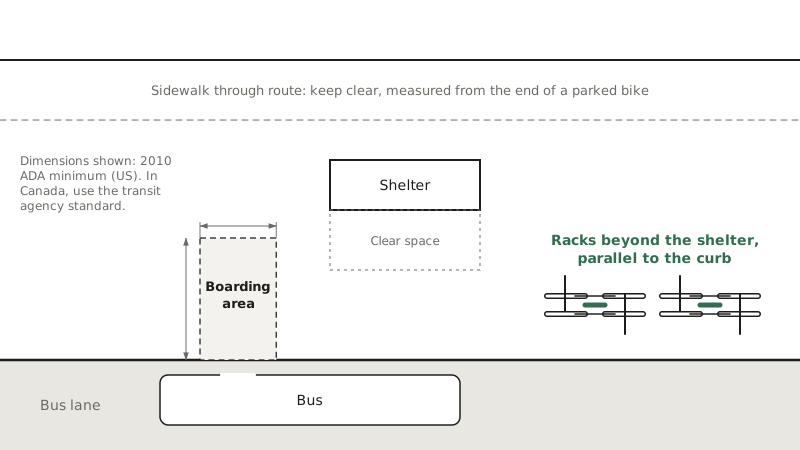
- Boarding area: keep the area where a bus ramp or lift deploys completely free of racks and parked bikes. The 2010 ADA Standards require new and altered bus stop boarding and alighting areas to have a firm, stable surface and a clear area at least 96 in (2440 mm) deep, measured from the curb, and 60 in (1525 mm) wide along the curb. Transit agencies often add their own requirements.
- Shelter clear space: keep the space inside and in front of a shelter clear for people using wheelchairs and mobility devices.
- Through route: the sidewalk past the stop must stay open. Measure from the end of a parked bike, not from the rack.
- Sightlines: bus drivers need to see waiting passengers, and passengers need to see approaching buses. Do not put parking where bikes block the view.
A common solution is to place racks just behind or beyond the shelter, in line with other street furniture, parallel to the curb.
Short visits and all-day parkers
Transit riders who park a bike are usually going somewhere for hours: work, school or an appointment. That means more parking at transit stops is long-term than at a typical store or office entrance. Plan for:
- Visible, well-lit racks close to the platform for people who are comfortable leaving a bike outside.
- Covered racks wherever possible. A bike left in rain or snow all day is a strong argument against riding to the stop next time.
- Secure parking at stations with heavy demand. Options include access-controlled bike rooms or cages, individual lockers rented by the month or hour, and staffed bike parking at the busiest hubs.
- Space for larger bikes. Some riders use cargo bikes or e-bikes to reach transit. A few longer spaces and, in secure areas, charging outlets help.
Our short-term and long-term parking guide explains the difference in more depth.
Design for a tough public site
Transit stops are busy, exposed and sometimes isolated at night. Durability and theft resistance matter:
- Use heavy-wall steel pipe racks with a galvanized base layer, since stops on major roads get road salt and spray from passing traffic.
- Fix racks with tamper-resistant fasteners, or embed them in concrete during stop construction.
- Light the parking area. Coordinate with the shelter lighting and street lighting.
- Place racks where they are watched by waiting passengers, station staff or cameras.
- Plan a routine to tag and remove abandoned bikes, which pile up quickly at transit sites.
Small-footprint racks like the Halo Circle Rack fit well on narrow stop platforms. At stations with more room, rows of inverted-U loops on rails are efficient and easy to expand.
Connect the parking to the network
Parking works best when the ride to it is comfortable. Check how cyclists actually reach the stop. If the only approach is a busy arterial with no bike lane, a protected crossing or a short connection to a nearby quiet street may do more for usage than extra racks. A few more connections to plan:
- Put a small sign at the station entrance pointing to secure parking, which is often out of sight.
- Place bike share docks near, but separate from, private bike parking so the two do not compete for the same space.
- Count parked bikes twice a year and share the numbers with the agency and the municipality, so both can see where demand is growing.
Snow and maintenance
Riders who use transit year-round need parking that is cleared in winter. Add the bike parking to the stop's snow clearing contract, keep racks out of plow windrows and snow storage areas, and check the area after storms. Racks buried under a snowbank for three months teach riders not to rely on them.
Funding and procurement
Bike parking at transit is often part of a larger stop or station project. In the USA, purchases usually go through bids or RFPs, or a cooperative purchasing contract. Projects that use federal transportation funds may be subject to Buy America requirements for steel and iron, so confirm the requirements with your funding agency and ask suppliers for documentation. Agencies with many stops often standardize on one or two rack models so replacements and spare parts are simple.
Frequently asked questions
Should every bus stop have a bike rack?
No. Many stops are too tight, and many riders take their bikes on the bus. Focus racks on busy stops, stops at the edge of the network and stops where counts show bikes locked to poles and shelters.
How close to the platform should racks be?
As close as possible without encroaching on the boarding area, shelter clear space or sidewalk route. A short walk in plain view of the platform is ideal.
Are bike lockers worth it at transit stations?
At stations where many riders leave bikes all day, yes. Lockers give the security that encourages people with more valuable bikes to ride to transit. Pair them with open racks, since many riders prefer not to rent a space.