Buying Site Furniture Through Public Procurement
How public bodies buy benches, racks and receptacles: choosing the right purchasing route, preparing a package suppliers can price accurately, and avoiding the delays that push installs into the next season.

Buying site furniture with public money means following a purchasing process. That process protects fairness and value, but it also adds time, and furniture often comes late in a project when the schedule is already tight. Knowing which route fits your purchase, and giving suppliers what they need the first time, makes the difference between an installation in spring and one that slips past the first snowfall.
Pick the right purchasing route
Which route you can use depends on the value of the purchase and your organization's purchasing policy. Cities, counties, school districts and agencies each set purchasing rules through state law and local ordinance, and the dollar thresholds for each method vary widely. Check your current thresholds with your purchasing department before you start.
Common routes include:
- Direct purchase or informal quotes. For small orders, such as a few benches to replace damaged ones, many policies allow a purchase order after one or a few written quotes.
- Invitation for bids (IFB) or request for quotation (RFQ). Used when the product is well defined and price decides. Bidders submit prices against your specification, and the lowest compliant bid usually wins.
- Request for proposals (RFP). Used when you want suppliers to propose a design or solution, such as a custom furniture family, and you will score on quality as well as price.
- Cooperative or group purchasing. Cooperative purchasing contracts and state contracts let agencies buy from an already competed contract, sometimes called piggybacking, if their own rules allow it. This can save weeks, but confirm the contract covers the products you need and that your organization is eligible to use it.
- As part of a construction contract. On capital projects, furniture is often supplied and installed by the general contractor under the project specifications.
Funding rules that change the process
Grants and other outside funding can bring their own conditions. Read them before you write the bid documents.
Federally funded transportation projects can carry Buy America requirements for iron and steel, and broader Build America, Buy America (BABA) provisions apply to many federally assisted infrastructure projects. These can affect where steel is melted and products are manufactured, and you may need supplier certifications. Disadvantaged business enterprise (DBE) goals may also apply. Confirm the requirements with the funding agency or your state DOT before bidding, since waivers and details vary.
What suppliers need to price accurately
Vague bid packages produce padded prices, clarification questions and addenda. A clear package gets sharper pricing. Include:
- Itemized quantities for each product, with model or performance specification.
- Colors and finishes by a standard code, such as a RAL number.
- Mounting method for each item, since surface mount, embedded and rail mount versions are priced differently.
- Scope: supply only, or supply and install. If installation is included, describe the existing surfaces and who provides concrete pads.
- Delivery details: the site address, whether a forklift or loading dock is available, delivery hours and whether items go to one location or several.
- Schedule: the required delivery window, not just the award date.
- Submittal requirements: drawings, samples and warranty documents you need before fabrication.
- Insurance, bonding and other compliance documents the supplier must provide.
Build realistic time into the schedule
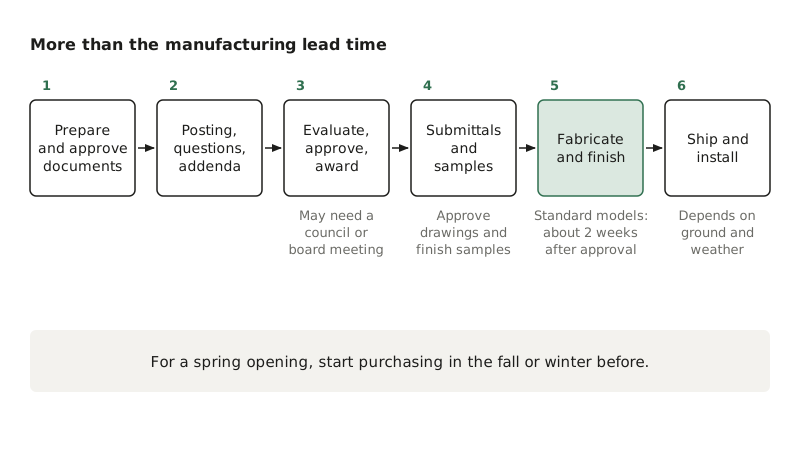
Furniture timelines are often underestimated because people count only the manufacturing lead time. A more complete timeline includes:
- Preparing and approving the bid documents.
- The posting period, plus time for questions and addenda.
- Evaluation, approval and award, which may need a council or board meeting.
- Submittal review and color sample approval.
- Fabrication and finishing.
- Shipping and installation, which in cold regions depends on ground and weather conditions.
Our standard models ship in about two weeks once drawings and colors are approved. That speed helps only if the steps before it are on time. If you need furniture in place for a spring opening, start the purchasing process in the fall or winter before.
Mistakes that cause trouble
- Writing around one product. If only one supplier can meet the spec without a valid reason, the process can be challenged. List the features that matter and allow equivalents.
- Mixing in unrelated items. Bundling furniture with playground equipment or lighting in one lot can limit competition. Consider separate lots.
- Skipping site details. A bid that says "install on existing surface" without saying what the surface is will attract allowances and change orders.
- Ignoring life-cycle cost. The cheapest bench is not cheap if it needs repainting in three years. Where policy allows, consider finish quality, warranty and parts availability in the evaluation.
- Approving samples late. Color sample approval is a common bottleneck. Assign a decision maker in advance.
Working with suppliers before you buy
Most purchasing rules allow, and encourage, general market research before a competition is posted. You can ask manufacturers for product data, standard drawings and specification text, and budget pricing for planning. Once a competition is open, all questions must go through the official channel so every bidder gets the same answers. Keep those two stages separate. Our team can supply drawings and data for planning through our resources page or by contacting us.
Frequently asked questions
Can we buy standard furniture without a full tender?
Often, if the value is under your informal purchasing threshold or you can use an eligible cooperative contract. The limits depend on your organization's policy, so confirm with purchasing.
Should furniture be bought separately from the construction contract?
Separate purchase gives the owner more control over product and timing. Including it in the construction contract simplifies coordination of pads and installation. Some owners buy the furniture directly and have the contractor install it.
What warranty should we ask for?
Ask for written warranty terms covering structure and finish, separately, and compare them across bids. Read what is excluded, such as vandalism and improper installation.