Writing Site Furniture Specifications
A good site furniture specification makes bids comparable and gets the product you designed delivered to site. Here is what to include and what to leave out.

Site furniture is often a small line in a large contract, and its specification gets less attention than the paving or the lighting. That is when problems appear: a bench arrives without a galvanized base, racks show up in the wrong color, or three bids quote three products that are not really comparable. A clear specification avoids most of this. It tells bidders exactly what performance and quality you expect, while leaving room for fair competition.
Choose your approach
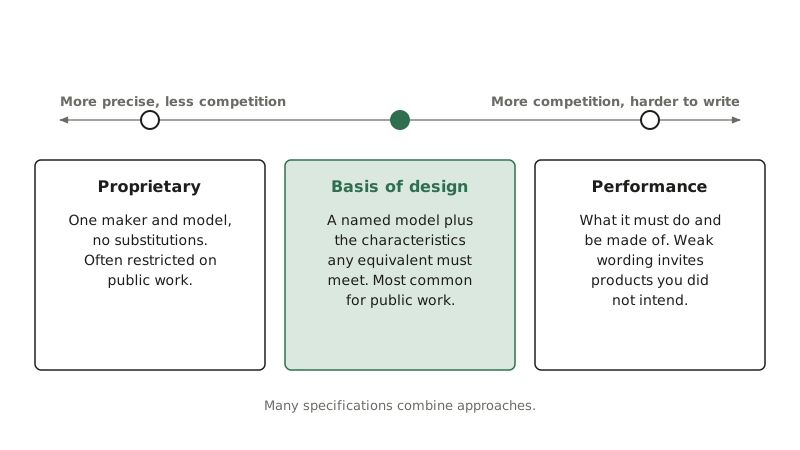
There are three common ways to specify furniture. Many specs combine them.
- Proprietary: names one manufacturer and model with no substitutions. Simple and precise, but many public owners restrict or prohibit it without justification.
- Basis of design with equivalents: names a model as the reference, then lists the features any equivalent must meet. This is the most common approach for public work.
- Performance: describes only what the product must do and be made of. It opens competition widely but takes more effort to write well, and weak wording invites products you did not intend.
If you name a basis of design, the salient characteristics you list are what bidders and reviewers will actually hold equivalents to. Spend your effort there.
What every furniture section should cover
Most site furniture specs follow the usual three-part format: general, products and execution. Within that, make sure each of the following is stated clearly.
Dimensions and configuration
- Overall length, width and height, with a tolerance.
- For seating: seat height, seat depth, back or backless, and armrest positions. Seat height near 18 in (450 mm) is a common target.
- For receptacles: capacity in gallons (liters), opening type and size, lid style and liner.
- For bike racks: number of bikes served, and that the rack supports a bike frame at two points and accepts a U-lock.
Materials
- Steel grade, tube or bar sizes, and minimum wall thickness for critical parts.
- Stainless grade where used, for example 304 or 316.
- Wood species and treatment, or recycled plastic content and color.
- Welding requirements, such as continuous welds at structural joints and ground smooth where people touch.
Finish
- Hot-dip galvanizing to the applicable standard, such as ASTM A123, where steel is galvanized.
- Pretreatment before powder coating.
- Powder type, such as a polyester suitable for exterior use, and minimum dry film thickness.
- Color by a standard reference, such as a RAL number, and gloss level.
Mounting
- Surface mount, embedded or rail mount, with the base or footing detail referenced on the drawings.
- Anchor type, material and size, and whether tamper-resistant fasteners are required.
- Who supplies anchors and who installs.
Submittals and quality checks
Submittals are how you confirm the product before it is built. Ask for:
- Product data sheets for each item.
- Shop drawings showing dimensions, materials, welds, finish and anchoring.
- Physical color samples on the same substrate and finish as the final product.
- Material samples for wood or recycled plastic, where color and grain matter.
- Warranty terms.
- Maintenance instructions and touch-up paint.
For substitution requests, require a side-by-side comparison against each listed characteristic. That makes review faster and fairer.
Accessibility and code references
Do not assume a product is accessible because it is sold as such. Accessibility depends on how and where it is installed. Reference the standards that apply to your project, which may include the 2010 ADA Standards for Accessible Design, state accessibility codes and the locally adopted building code. State the clear floor space and route requirements on the drawings, not only in the spec. Requirements vary by jurisdiction, so confirm them with the authority having jurisdiction.
Delivery, installation and closeout
- Delivery: state whether the site has a loading dock or forklift, or whether items must arrive on a truck with a liftgate. Note any delivery hour restrictions.
- Protection: require packaging that protects the finish, and inspection on arrival before signing for the delivery.
- Installation: require installation to the manufacturer's instructions, level and plumb, with damaged coatings touched up.
- Spare parts: consider asking for spare slats, liners, fasteners and a key or tool for any tamper-resistant fasteners.
- Closeout: collect warranty documents, finish codes and supplier contacts in the operations and maintenance manual.
Common mistakes
- Copying a manufacturer's marketing text into the spec. It is often vague where it matters and over-specific where it does not.
- Specifying powder coat with no mention of galvanizing or pretreatment.
- Listing a color by name only, such as "dark green".
- Requirements in the spec that conflict with the drawings.
- Forgetting quantities and locations, so bidders guess.
- Setting tolerances so tight that only one product can comply, which defeats the point of allowing equivalents.
If you are writing a spec around a standard product, ask the manufacturer for its spec text and drawings, then edit them to your requirements. Most of our models, from the slat receptacle to the Loop Rack, have drawings and specification data available on request through our resources page.
Frequently asked questions
Should the spec include a price or budget?
No. Keep budgets in your own estimate. A spec describes the product and the work. Listing a price can distort bids.
How detailed should equivalence criteria be?
List the characteristics that affect use, durability and appearance, such as dimensions within a tolerance, material, finish system and mounting. Skip details that do not matter to performance.
Who should review furniture submittals?
The designer who wrote the spec, ideally with input from the owner's maintenance staff, who will live with the product for many years.