Bollard Installation and Footings
How a bollard is installed decides how much it can resist. This guide compares embedded and base-plate mounting, covers footing size, frost, utility locates and the steps for a clean, plumb installation.
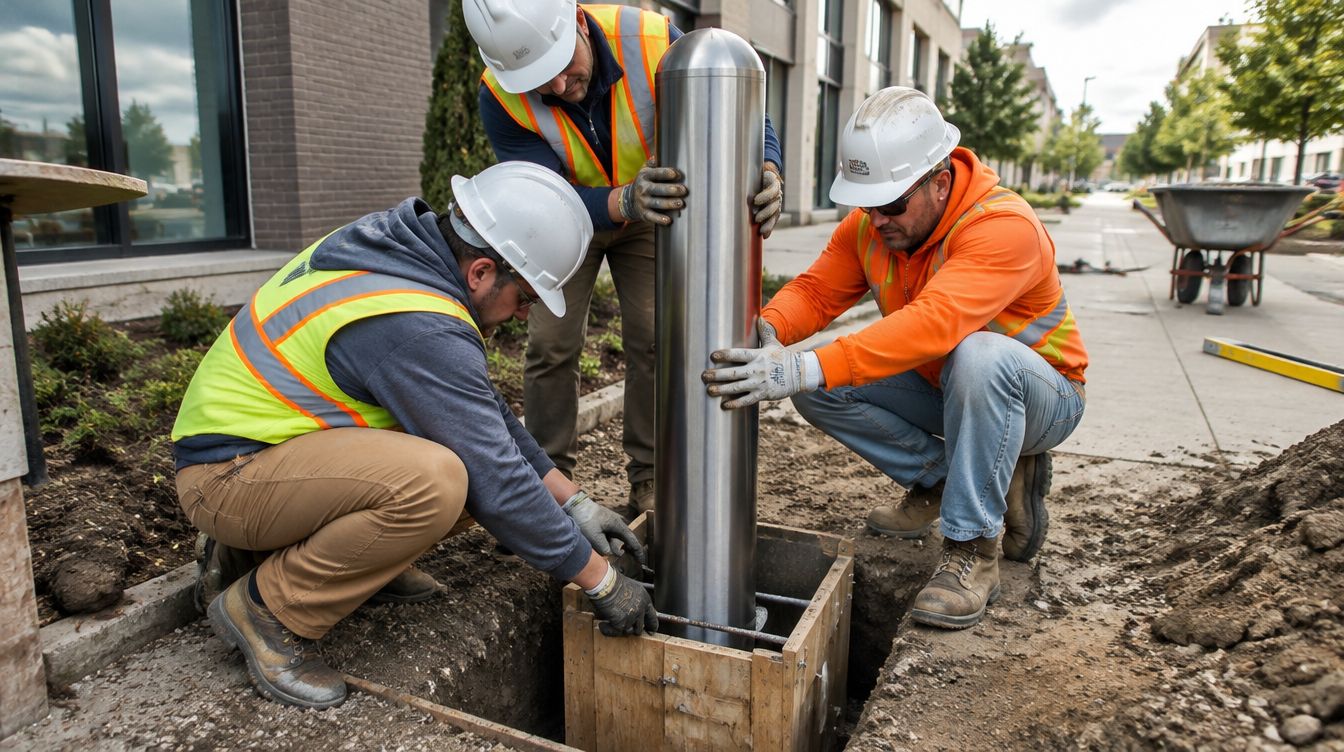
Two identical steel bollards can perform very differently depending on how they are installed. A bollard set deep in a concrete footing can take a real bump from a car. The same bollard bolted to a thin slab may tear out its anchors at walking pace. Installation is where most of a bollard's strength comes from, so it deserves as much attention as the bollard itself.
Embedded versus base-plate mounting
| Embedded | Base plate | |
|---|---|---|
| How it is fixed | Post set in a concrete footing below grade | Plate bolted to an existing slab with anchors |
| Impact resistance | Higher, depends on footing and soil | Low, limited by anchors and slab |
| Digging | Yes, core or excavation | No, only drilling |
| Installation time | Longer, concrete must cure | Fast |
| Removal later | Difficult | Easy |
| Best for | Protecting buildings, patios and people | Guidance on existing slabs, over utilities, on structures |
Base-plate bollards are useful where digging is not possible, such as on a parking deck, over a shallow utility, or on a slab you cannot cut. Treat them as visual guidance. If you need the bollard to stop a car, embed it.
Check what is underground before you dig
Bollard footings go deep enough to hit buried power, gas, water and telecom lines. Striking a line is dangerous and expensive. Before any digging or core drilling:
- Call 811 or submit a request online to have public utilities marked. The service is free, and state laws require a request before digging.
- Arrange a private locate for lines the public service does not mark, such as site lighting, irrigation and private water or electrical lines on the property.
- Review as-built drawings for the site, including drains and older services that may not be marked.
- Hand dig or use hydro-excavation near marked lines, as the locate rules require.
Also check for post-tensioned slabs. Drilling or coring into a post-tensioned slab can cut a tendon. Have the slab scanned before you drill.
Footing size and depth
For a non-rated steel pipe bollard, a common footing is a round hole about two to three times the bollard diameter, with depth roughly equal to the height above grade or more. For a typical bollard about 3 ft (900 mm) tall, footings of 3 to 4 ft (900 mm to 1.2 m) deep are common. These are rules of thumb, not a design.
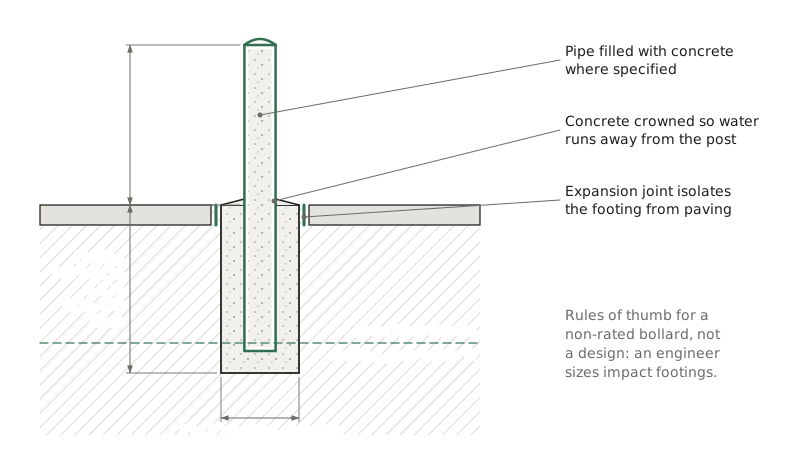
Several things change the answer:
- Frost depth. In cold climates, footings that stop above the frost line can heave. Frost depths vary a lot across the country, so check the local building department's figure.
- Soil. Soft clay, fill or high water tables reduce resistance. A geotechnical report helps on large projects.
- Expected impact. If the bollard must resist a vehicle, have an engineer size the footing. Crash-rated bollards must use the footing from their tested design.
- Nearby paving. Isolate the footing from surrounding slabs with an expansion joint, so a hit on the bollard does not crack the paving.
Installation steps for embedded bollards
- Lay out locations and confirm spacing, clearances and utility marks.
- Core drill or saw cut existing paving, then excavate to the required depth.
- Compact the base and add drainage gravel if the design calls for it.
- Set the bollard, or its embedded sleeve, to the correct height. Brace it plumb in two directions.
- Place concrete around the post, consolidate it to remove voids, and slope the top away from the post so water does not collect at the base.
- Check plumb and height again before the concrete sets.
- Let the concrete cure as specified before removing braces or allowing any impact.
- Fill steel pipe bollards with concrete if specified, and finish the cap.
Installing base-plate bollards
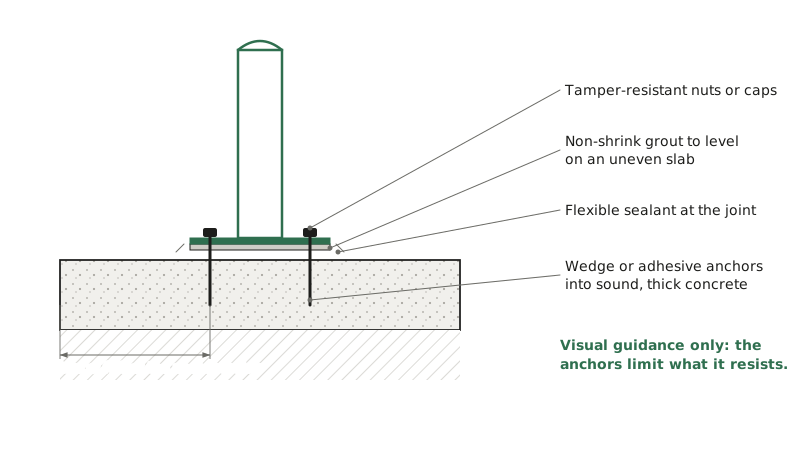
Use anchors suited to the slab and the load. Wedge anchors and adhesive anchors are both common. Follow the anchor maker's minimum edge distance, spacing and embedment. Anchors placed too close to a slab edge or crack can break out. The slab itself needs to be sound and thick enough for the anchors. Use tamper-resistant nuts or caps in public spaces, and level the plate with non-shrink grout if the slab is uneven.
Common installation mistakes
- Setting height by eye. Grade changes along a row make bollards step up and down. Set every top to a string line or laser level.
- Pouring around a wet hole. Pump out standing water first, or the concrete around the post will be weak.
- Removing braces too soon. Pulling braces early lets posts lean out of plumb before the concrete has set.
- Skipping the expansion joint. A footing poured tight against new paving transfers every bump into the slab.
Protecting the finish and the base
The point where steel meets concrete is the most likely place for corrosion. Salt, water and plow damage gather there.
- Choose a galvanized and powder-coated finish for steel bollards, especially where road salt is used.
- Keep the concrete crowned so water runs away from the post.
- Seal the joint at the base with a flexible sealant on base-plate installations.
- Touch up any coating damaged during installation before it is exposed to winter.
Our Fixed Bollard ships in embedded and base-plate versions with installation drawings. Contact us if your site has utilities or slabs that limit footing depth.
Frequently asked questions
Can I install bollards in asphalt?
Not with a base plate. Asphalt is too soft for anchors. Core through the asphalt and set the bollard in a concrete footing below.
How long before an embedded bollard is ready?
The bollard is usually firm within a day, but concrete gains strength over several weeks. Follow the concrete supplier's curing guidance before exposing it to impacts.
Do I need a permit?
Often, especially in a public right-of-way. Check with the municipality for street work, and with the building department for footing depth.