How to Choose a Bike Rack
A good bike rack holds a bike upright by its frame, takes a standard U-lock and fits the space without blocking anyone. Here is how to judge a rack before you buy it.
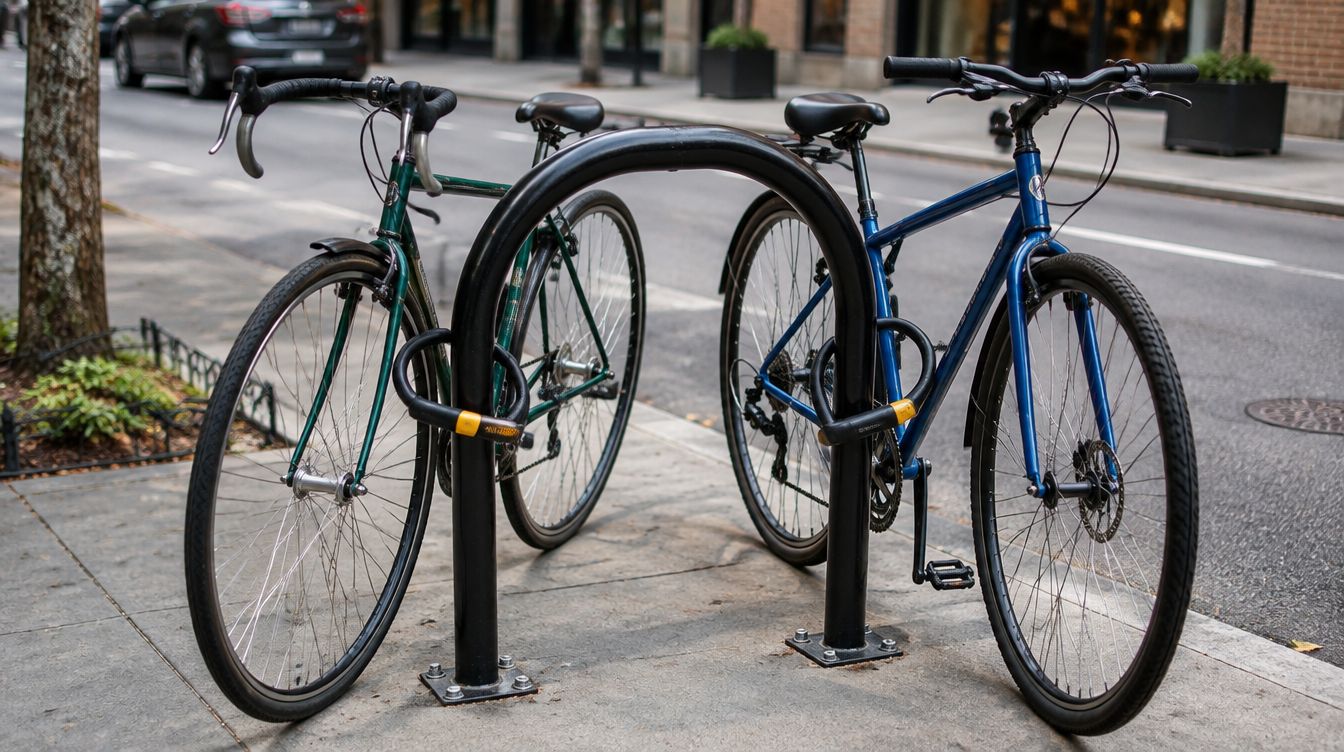
Most bike racks look fine in a catalog photo. The difference shows up a month after installation, when bikes are leaning on each other, wheels are bent and half the spaces sit empty because nobody can work out how to use them. Choosing well comes down to a few practical tests. If a rack passes them, cyclists will use it. If it fails, they will lock to the nearest railing, tree or sign post instead.
Start with the bike, not the rack
A rack has one job: let someone lock a bike quickly and leave knowing it will still be there and still be straight. Before comparing products, think about who will park. A downtown shop sees commuters with road bikes and heavy U-locks. A park sees families with children's bikes. A campus sees everything, including e-bikes, cargo bikes and bikes with baskets and child seats.
Ask a few questions early:
- How long will bikes stay? Under two hours is short-term parking. A full workday or overnight is long-term and usually needs shelter and more security.
- What mix of bikes do you expect? Heavier e-bikes and longer cargo bikes need more room and a sturdier rack.
- Is the site exposed to road salt, snow clearing or vandalism? That affects material, finish and mounting.
The core tests a good rack must pass
The bike parking guidance most planners use in the United States is the Association of Pedestrian and Bicycle Professionals (APBP) Essentials of Bike Parking. Its performance criteria are a sensible checklist for any rack. In plain terms, a good rack should:
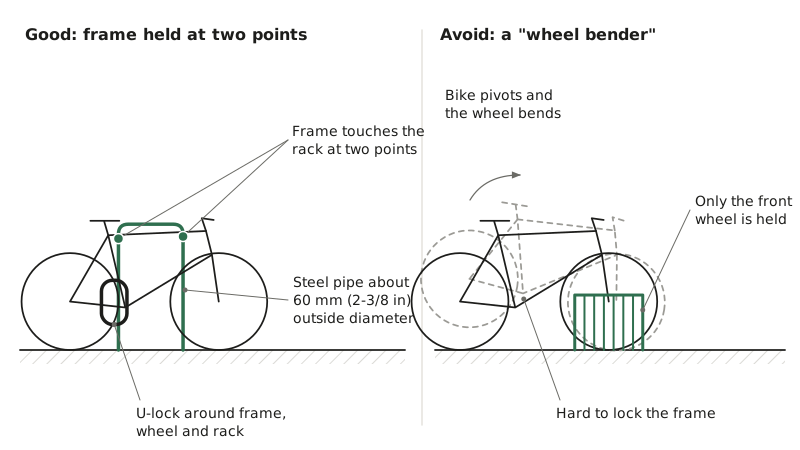
- Support the frame at two points. A bike touching the rack in two places, spaced apart, cannot swing or fall over. A rack that only holds a wheel lets the bike pivot, and the wheel bends.
- Take a U-lock around the frame and one wheel. Most experienced cyclists carry a U-lock. If the rack tube is too thick, or the shape keeps the frame away from the rack, the lock will not fit.
- Work with many bike types. Step-through frames, small children's bikes, fat tires, fenders and baskets should all park without a struggle.
- Allow front-in or back-in parking. People should not have to lift a bike or thread a wheel through a slot.
- Be obvious to use. If someone has to guess which way the bike goes, many will guess wrong and take up two spaces.
Racks that fail these tests are often called "wheel benders": low grids or slots that grip only the front wheel. They are cheap and look tidy when empty, but they damage bikes and are hard to lock to securely. Avoid them for public parking.
Tube size, material and finish
Most quality racks are made from steel pipe around 2-3/8 in (60 mm) outside diameter. That size is thick enough to resist casual cutting and bending, yet thin enough for a standard U-lock to close around the rack, the frame and a wheel. Very thick square tube looks strong but can make locking awkward. Thin-wall tube is lighter and cheaper but easier to cut with a pipe cutter.
For the finish, the usual choices are:
- Hot-dip galvanized: durable, low maintenance, a plain silver look that dulls over time.
- Powder coat over galvanizing: the best option for color and long life together. The zinc layer protects the steel if the coating gets chipped by locks and pedals.
- Powder coat over bare steel: fine indoors, but outdoors it tends to rust where locks scrape it.
- Stainless steel: excellent in harsh coastal or salted settings and for high-end architecture, at a higher price.
Racks take constant abrasion from locks and chains. In regions where roads and sidewalks are salted every winter, a galvanized base layer pays for itself.
Footprint and capacity: count usable spaces
Manufacturers list capacity, but the real number depends on layout. A typical bike is about 6 ft (1.8 m) long, so each side of a rack needs that much parking depth. A two-sided inverted-U rack holds two bikes, one on each side. Placing racks too close together turns two-bike racks into one-bike racks.
Be wary of capacity claims on long continuous racks. If a rack is advertised as holding nine bikes but in practice people park parallel to it, you may get four or five. Count the spaces where a bike can touch the rack at two points with room to lock, and plan with that number. Our spacing and layout guide covers the clearances in detail.
Mounting and site conditions
How a rack attaches to the ground matters as much as its shape. The three common options are:
- Surface mount: base flanges bolted to an existing concrete slab with tamper-resistant anchors. Quick, and racks can be moved later.
- In-ground (embedded): legs set into concrete. Very secure and clean-looking, but permanent and best done during construction.
- Rail mount: several racks fixed to a pair of rails, which can sit freestanding or be anchored. Useful on surfaces you cannot drill, or for seasonal parking.
Avoid mounting into pavers, asphalt or thin slabs without a proper footing, since anchors pull out over time. Check whether snow clearing equipment will pass by, and keep racks where plows will not hit them.
Mistakes to avoid
- Choosing a rack for looks alone. Sculptural racks are welcome, but they still need two points of contact and room for a U-lock.
- Putting racks out of sight. Racks behind a building or far from the entrance go unused, and bikes in hidden spots are easier to steal.
- Blocking the accessible route. Parked bikes stick out well past the rack. Keep the pedestrian path clear and meet the 2010 ADA Standards and local accessibility rules.
- Buying too few. Under-supplied racks lead to bikes locked to trees, railings and benches.
- Ignoring larger bikes. Leave at least one or two end positions with extra room for cargo bikes, trailers and adaptive cycles.
Matching rack styles to sites
For most sidewalks and building entrances, a simple inverted-U such as our Loop Rack or a post-and-ring such as the Halo Circle Rack is hard to beat. Each holds two bikes at two points and takes up very little room. Where you want a stronger design statement or a custom shape, almost any profile can work as long as it keeps the same contact points and locking clearance. Our rack styles comparison covers the trade-offs between common shapes.
Frequently asked questions
What is the best all-round bike rack?
For most public sites, an inverted-U or post-and-ring rack made from galvanized steel pipe. It supports the frame at two points, accepts any U-lock, suits almost every bike type and uses little space. Fancier shapes can work, but they should meet the same basic tests.
Do I need a different rack for e-bikes?
Not usually a different shape, but e-bikes are heavier and often longer. Make sure the rack is anchored firmly, leave a little more space between racks and consider some covered long-term spaces, since many riders will not leave an expensive e-bike outside all day.
How many bikes does a rack really hold?
Count the positions where a bike can lean against the rack at two points and be locked. For inverted-U and ring racks that is normally two bikes per rack, one per side, if racks are spaced properly. Continuous or wave-style racks often hold fewer bikes in practice than their rated capacity.