Circle, Arc, Loop and Wave Racks Compared
Circle, arc, loop and wave racks all hold bikes, but they differ in footprint, real capacity and how easy they are to use. Here is where each one fits best.
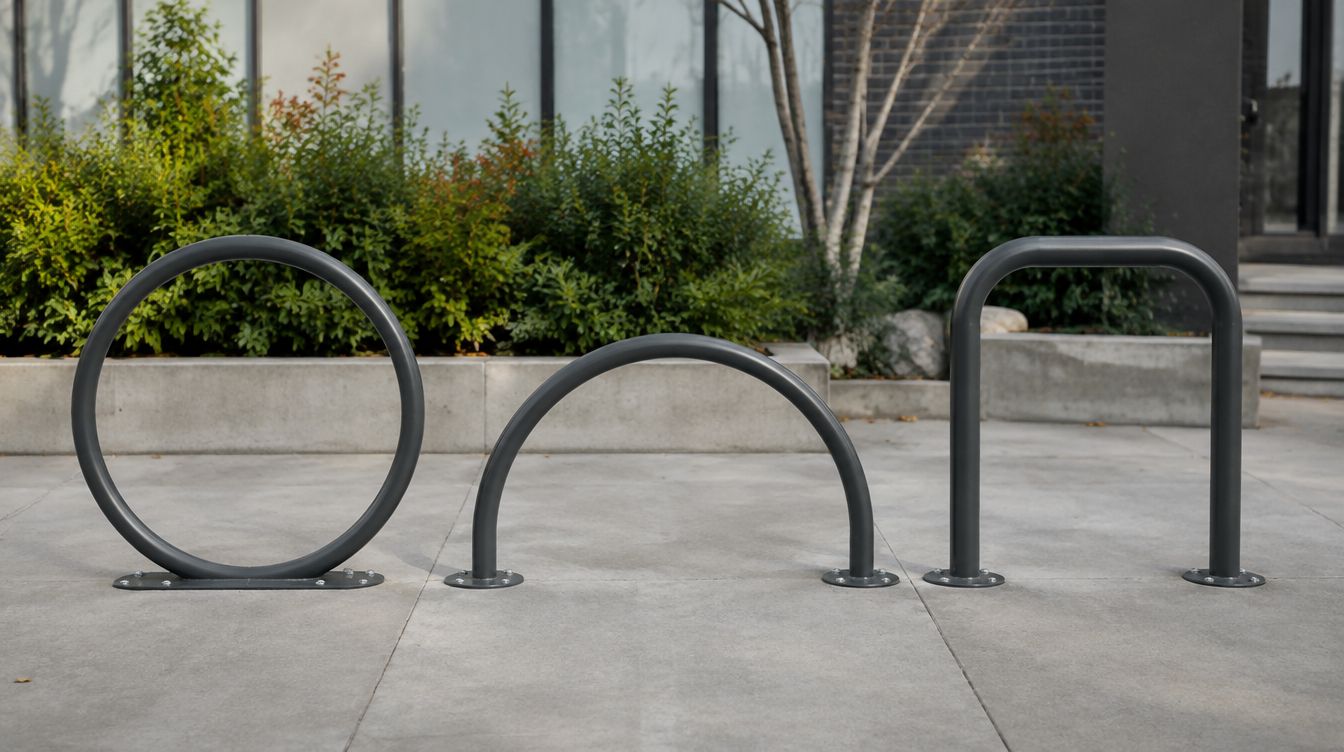
Walk through any city and you will see a dozen rack shapes. Most of them are variations on four basic forms: the circle or post-and-ring, the arc, the inverted-U loop and the continuous wave. Each has a sound reason to exist and each has limits. This guide compares them on the things that matter after installation: how the bike is supported, how many bikes actually park, how much space they take and where they look and work best.
Whatever the shape, a rack should hold a bike upright by its frame at two points, let a U-lock go around the frame and a wheel, and work for different bike types without lifting. Those criteria come from APBP's Essentials of Bike Parking, which is widely used in the USA. Shape is mostly a question of footprint, appearance and how many bikes you can fit in a given space. Our rack selection guide explains the criteria in more depth.
Circle (post-and-ring) racks
A ring held up on a short post or pair of legs. Bikes park on either side of the ring and lean against it at two points along the curve.
- Strengths: very small footprint, so it fits narrow sidewalks and tight corners. Reads clearly as a bike rack. Works well parallel to the curb.
- Limits: holds two bikes. Smaller rings can give a short contact span on large frames, so look for a ring around 20 in (510 mm) across.
- Best for: downtown sidewalks, storefronts, streetscapes where clutter is a concern, and sites where racks are scattered in ones and twos.
Our Halo Circle Rack is this type.
Arc racks
A half-circle of pipe with both ends anchored at ground level. It is wider and lower than an inverted-U, which gives it a softer, more sculptural look.
- Strengths: long contact surface, so bikes of many sizes can find two support points, including children's bikes. Attractive in parks and plazas.
- Limits: takes more length than an inverted-U for the same two bikes. Near the ends, the pipe is low, which can tempt people to park in awkward spots.
- Best for: parks, landscaped areas, campuses and schools, where appearance matters and there is room.
Inverted-U (loop) racks
The most common rack in North America: a single bent pipe shaped like an upside-down U, typically around 36 in (915 mm) high and 18 in (460 mm) wide. Bikes park on each side, parallel to the rack.
- Strengths: simple, sturdy, and the benchmark against which other racks are judged. Supports the frame at two points at a comfortable height. Easy to install individually or on rails in sets of several loops.
- Limits: plain looking unless finished in a color or customized. Needs proper spacing between loops to deliver two bikes each.
- Best for: almost anywhere, from building entrances to large parking areas. If you are unsure which rack to use, use this one.
Wave (serpentine) racks
A long continuous pipe bent into a series of humps. Bikes are meant to park through the bays, perpendicular to the length of the rack.
- Strengths: one piece holds several bikes, so installation is quick. Familiar shape and often a low price per advertised space.
- Limits: many cyclists park alongside the wave instead of through it, which uses up two or three bays with one bike. Bikes in the bays often touch the rack at only one point, so they can tip. Real capacity is often well below the rated number. Bike parking professionals generally prefer separate inverted-U racks for this reason.
- Best for: sites with predictable users who are shown how to use it, such as schools with supervised parking, or as a budget option where a single piece is needed. If you use one, plan the approach space carefully and count capacity conservatively.
We make a Wave Rack for customers who need one, but for most public sites we recommend loops.
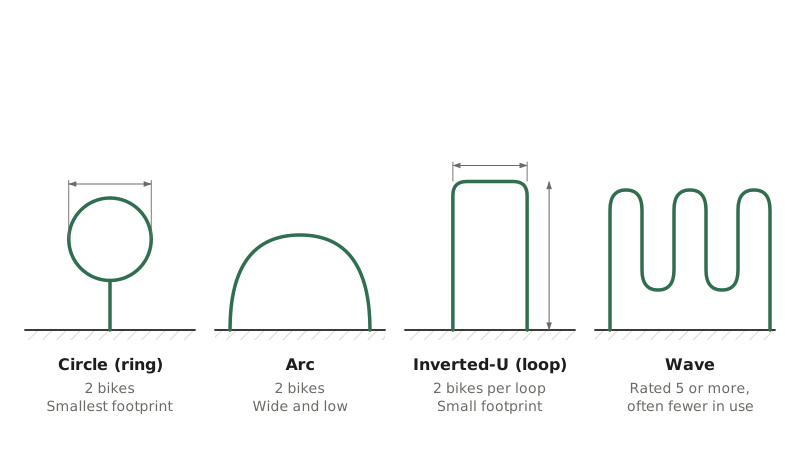
Side-by-side comparison
| Style | Bikes per unit | Footprint | Ease of use | Typical setting |
|---|---|---|---|---|
| Circle | 2 | Smallest | Very easy | Narrow sidewalks, storefronts |
| Arc | 2 | Wide, low | Easy | Parks, plazas, campuses |
| Inverted-U loop | 2 per loop | Small | Very easy | Almost anywhere |
| Wave | Rated 5 or more, often fewer in use | Long, one piece | Often misused | Supervised or budget sites |
Other shapes you will see
- Grid or comb racks: rows of vertical bars that hold the front wheel only. They fail the two-point test, bend wheels and should be avoided for public parking.
- Vertical and wall-hung racks: bikes hang by a wheel. They save floor space in indoor rooms but many people cannot lift a heavy bike, so always provide some floor-level spaces too.
- Two-tier racks: double the density in bike rooms and stations, using lift-assisted upper trays. Good for long-term parking indoors.
- Custom and sculptural racks: logos, letters and shapes. These add character and can carry a brand, as long as the design keeps two support points and room for a U-lock.
Choosing between them
Start with space and setting, then let appearance decide among the shapes that fit:
- Narrow sidewalk or small entrance: circle or inverted-U, parallel to the curb.
- Landscaped park, plaza or school: arc or inverted-U.
- Large parking area: inverted-U loops on rails or individually in rows.
- Strong design or branding goal: a custom shape built on the same principles. See our custom work.
Mixing styles on one site is fine, but keep one family per area so users quickly learn how to park.
Frequently asked questions
Which rack style holds the most bikes?
Per square meter of ground, a row of properly spaced inverted-U loops is hard to beat in outdoor settings. Wave racks claim more per unit but often hold fewer in practice. Indoors, two-tier racks give the highest density.
Are wave racks bad?
They are not dangerous, but they are often used incorrectly, which reduces capacity and leaves bikes poorly supported. They work best where users are guided, such as at a supervised school. For public sites, separate loops perform better.
Can a custom rack shape still meet guidelines?
Yes. Any shape can work if it supports the frame at two points, accepts a U-lock around the frame and a wheel, and leaves enough room around it. Ask the maker to show how a bike parks on the design before you approve it.