Planters for Traffic Calming and Street Closures
Heavy planters are one of the fastest ways to narrow a street, close a lane or carve out a plaza. Here is how to size, place and mark them so they work and stay safe.
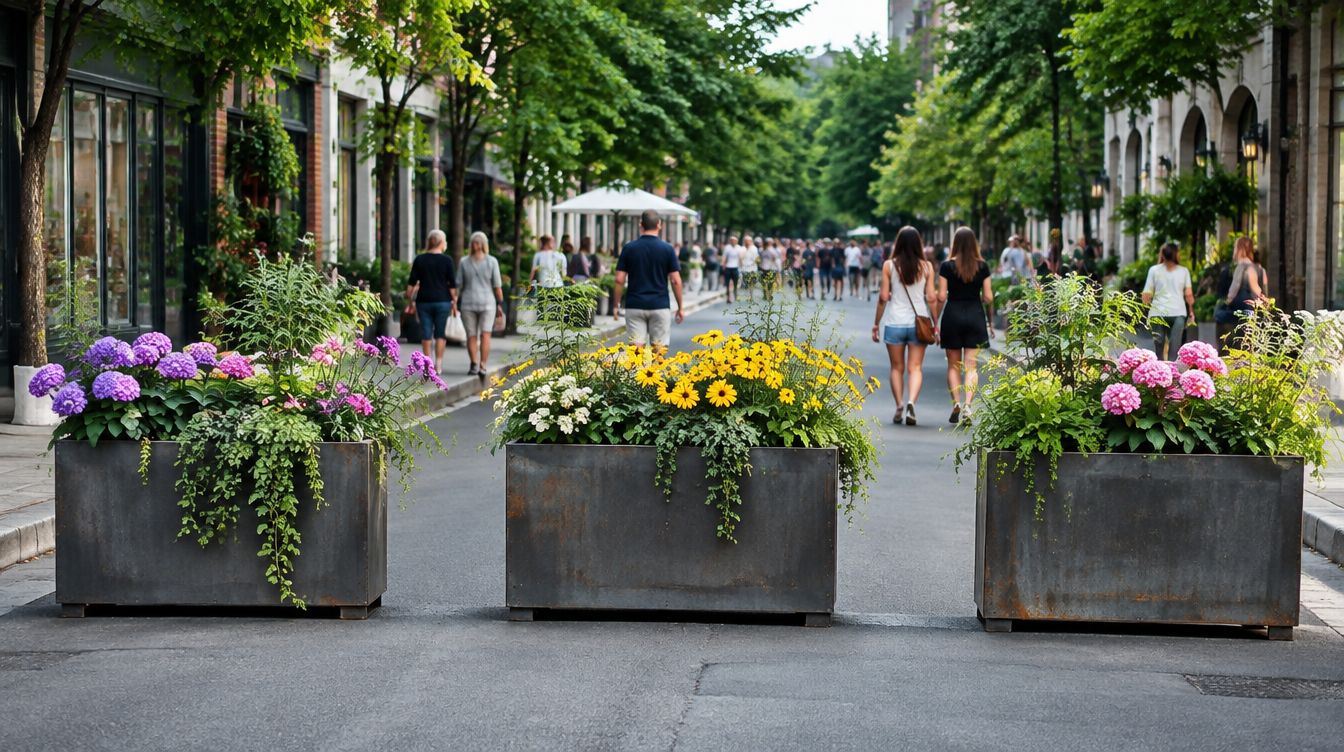
Large planters have become a standard tool for changing how a street works without rebuilding it. A row of planters can turn a parking lane into a patio, narrow a wide residential street, or close a block to through traffic for a summer. They cost far less than concrete curb work, they can be moved if the layout needs adjusting, and they make the new space look intentional rather than temporary.
They also have limits. A planter is a visual and physical cue that guides drivers. It is not a security barrier. This guide covers what planters do well, how to lay them out, and the details that keep a pilot project from becoming a problem.
What planters can and cannot do
Planters work by changing how drivers read the street. A narrower travel lane, a bend in the road or a visible closure makes most drivers slow down or choose another route.
What they do not do is reliably stop a vehicle traveling at speed. Even a heavy planter full of wet soil can be pushed, tipped or ridden over in a collision, and it can become a hazard itself if it shifts. Unless a planter has been tested and certified to a recognized vehicle impact standard, treat it as a deterrent and a guide, never as protection against a deliberate or high-speed impact. Where that level of protection is needed, such as a crowded plaza beside a fast road, use crash-rated bollards or barriers designed by a qualified professional and let the planters handle the softer work around them.
Common layouts
- Lane narrowing. Planters placed along the edge of a wide lane reduce the space drivers see and tend to lower speeds.
- Chicanes. Staggered planters on alternating sides force a gentle S-curve. Keep the offsets long enough that delivery trucks and buses can still get through if they use the street.
- Curb extensions. A cluster of planters at a corner acts like a temporary bump-out. It keeps parked cars back from the crosswalk.
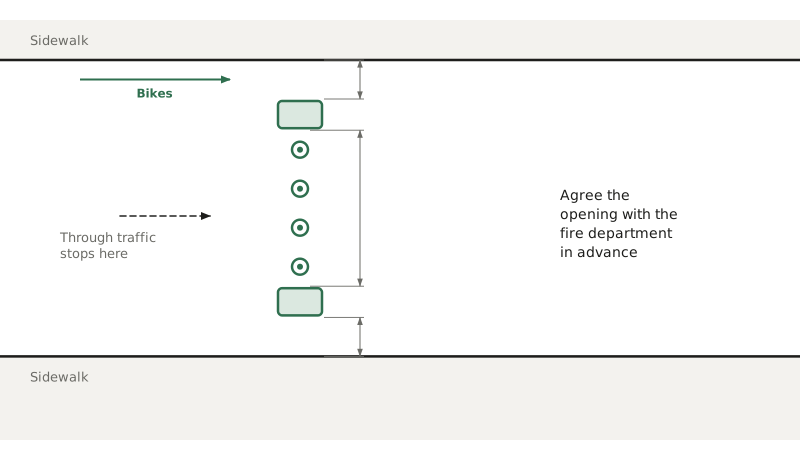
- Diverters and modal filters. Planters across a street block through traffic while leaving gaps for bikes and people walking. This is a common approach for quiet streets and school streets.
- Patio and plaza edges. Planters separate seating from the travel lane and give curbside patios a sense of enclosure.
Weight, size and stability
Mass is what makes a planter stay put. Moist planting soil commonly weighs somewhere in the range of 70 to 100 lb per cubic foot (about 1,100 to 1,600 kg per cubic meter), so a large planter can easily pass a tonne once filled and watered. That weight resists casual shoving, sliding from snowplow contact and wind, but it also means you need equipment to move it.
- Choose planters with a low center of gravity and a wide footprint. Tall, narrow planters tip more easily.
- Specify forklift pockets or lifting points if you plan to move planters seasonally. Moving a full planter by dragging damages both the planter and the pavement.
- For long runs, linear planters such as our Linear Planter create a continuous edge with fewer gaps than a line of small pots.
- Check that the pavement can carry the load. A loaded planter on a thin sidewalk slab over a vault or basement needs a structural check.
- Where planters may be disturbed, ask about anchoring options. Some projects pin planters to the pavement; others rely on weight alone so they can be relocated.
Clearances and access
A traffic calming layout has to keep working for people who are not driving through. Plan these clearances before placing a single planter, and confirm the exact figures with the road authority, since they vary by jurisdiction.
- Emergency access. Fire departments usually need a clear route for their apparatus, often around 20 ft (6 m) wide on designated access routes. If a closure blocks that route, use removable bollards or a movable planter section and agree on the plan with the fire department in advance.
- Accessible paths. Do not let planters pinch the sidewalk. Keep a continuous clear walking route that meets the 2010 ADA Standards and any stricter local rules, and keep curb ramps and crosswalk landings fully open.
- Bike gaps. In a modal filter, gaps should let cargo bikes, trailers and adaptive cycles through comfortably, while being narrow enough to stop cars. Many cities use gaps of about 5 ft (1.5 m), sometimes with a bollard in the middle of a wider opening.
- Drainage. Leave a gap between the planter and the curb face so gutter water can flow and street sweepers can clear debris.
- Utilities. Keep planters off manholes, valve boxes, catch basins and hydrant clearance zones.
Visibility, marking and sightlines
A planter in the roadway is an object drivers can hit, so it must be easy to see in rain, at night and in snow. Fit retroreflective markers or tape to the faces that meet traffic, and consider a flexible delineator post on the leading planter of each run. Many agencies follow the MUTCD for object markers and delineation, so check what your city or state DOT expects.
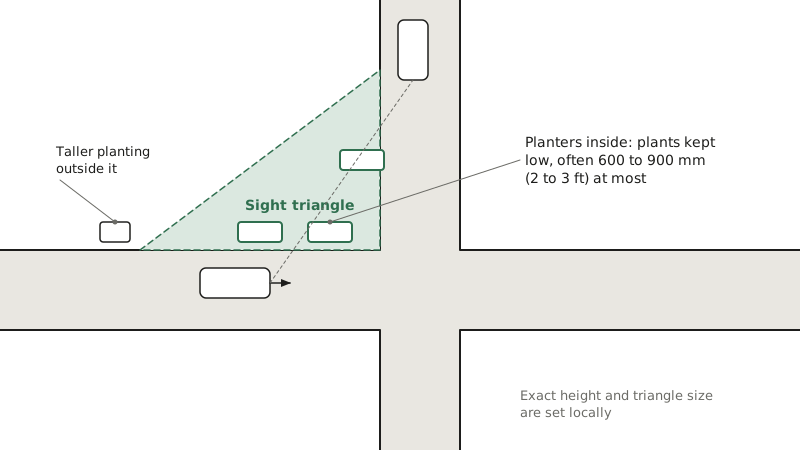
Plant height matters near corners. Keep plantings low inside intersection sight triangles so drivers can see children and people using wheelchairs. Many jurisdictions limit obstructions in those zones to roughly 2 to 3 ft (600 to 900 mm), but the exact height and triangle size are set locally.
Approvals, pilots and winter
Placing objects in a public road usually needs permission from the road authority, and often sign-off from transit, fire and waste collection. A pilot is a good way to test a layout. Set clear goals, measure before and after, and be ready to shift planters if something is not working.
Winter needs its own plan in snow regions. Plow operators need to know where planters are, so taller delineators or snow stakes are useful. Decide whether planters stay out year round or get pulled in before the first snowfall. Planters left in place should be heavy enough that a plow blade nudging them does not send them into the lane, and their finish should be able to cope with salt and slush. In salt-belt states, galvanized and powder-coated steel holds up better than bare or painted steel.
Quick planning checklist
- Define the goal: slower speeds, fewer cut-through drivers, or new space for people.
- Sketch the layout over a recent aerial or survey, with lane widths and turning paths.
- Mark emergency routes, transit stops, driveways, loading zones and utilities.
- Confirm clearances and marking requirements with the road authority.
- Select planter sizes and weights, plus any delineators or removable bollards.
- Plan who waters, weeds and moves the planters, and when.
Frequently asked questions
Can planters replace bollards for protecting a patio?
For low-speed streets they can define the patio edge and discourage drivers from drifting toward it. They are not a substitute for rated barriers where a vehicle could approach at speed. Assess the risk honestly, and if the site needs real vehicle protection, use crash-rated products designed for that job.
How many planters do I need for a street closure?
Measure the full width you want to close, subtract the gaps you need for bikes, pedestrians and emergency access, then divide by the planter length. Add one or two spares if you expect damage or want to adjust the layout during a pilot.
Should planters for traffic calming be planted at all?
Yes, if someone will look after them. Healthy plants signal that a space is cared for, which encourages people to respect it. Empty or dead planters look abandoned. If watering is uncertain, choose tough, drought-tolerant plants or set up a maintenance agreement with a business or community group.