Recycling Stations and Signage
Public recycling only works when people can sort in a few seconds. How to choose the number of streams, colors, openings and signs that keep contamination down.
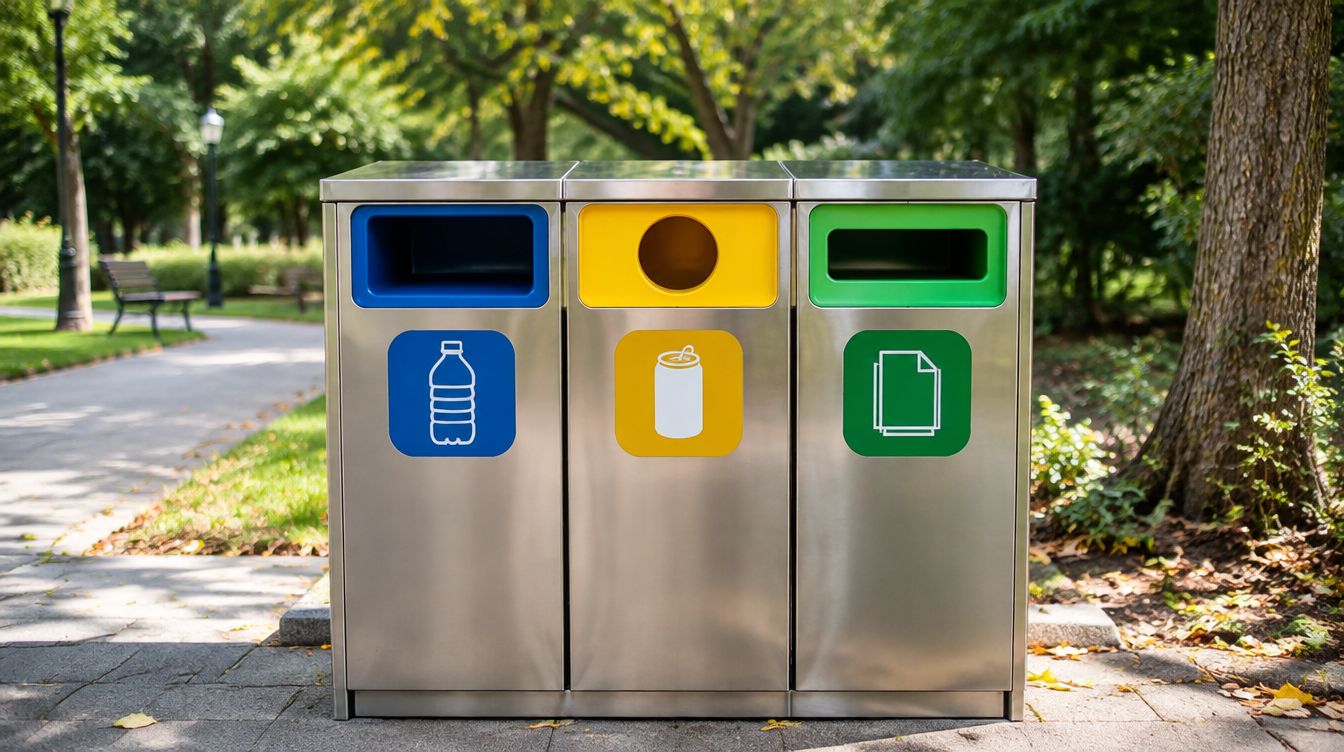
Recycling in public spaces is harder than recycling at home. People are walking, distracted and holding something they want to get rid of. They give a bin a second or two of attention. If the right choice is not obvious in that time, the item goes in whichever opening is closest. A contaminated load may be rejected by the processor and sent to landfill anyway. Good stations make sorting quick and obvious, and that comes from a few clear decisions about streams, colors, openings and signs.
Start with your hauler and processor
Before choosing any bins, find out exactly what your collection contractor or municipal program accepts from public-space bins. Rules vary between cities and between residential and commercial programs. Some accept mixed containers but not paper. Some accept paper cups, others do not. Some take organics, many do not from street bins.
Ask:
- Which streams are collected from this site, and are any combined (single-stream)?
- Which items are accepted in each stream?
- What contamination level leads to a load being rejected?
- Do crews need to keep streams in separate bags or colors of bag?
Design the station around these answers. A station with four streams is pointless if the truck tips everything into one compartment.
How many streams?
| Setup | Typical streams | Works best |
|---|---|---|
| 2 streams | Landfill, mixed recycling | Streets, parks, transit stops |
| 3 streams | Landfill, containers, paper; or landfill, recycling, organics | Campuses, offices, food courts |
| 4 streams | Landfill, containers, paper, organics | Supervised sites with staff and strong programs |
More streams can recover more material, but each added choice slows people down and increases sorting errors. For most outdoor public spaces, two or three streams is the practical limit. Add a stream only when the program accepts it and there is enough of that material to justify the space.
Always pair recycling with a landfill opening. A recycling bin standing alone becomes the garbage bin for everyone who cannot find one nearby. Combined units such as our Stream 3 Recycling station keep the streams together so people make a choice instead of a guess.
Colors
There is no single color standard for recycling in North America. Many programs use blue for recyclables, green for organics and black or gray for landfill, but local practice varies. The most important rule is consistency:
- Match the colors of your local residential program, since that is what people already know.
- Use the same color for the same stream everywhere on your site, on bins, lids, bags and signs.
- Do not use the stream colors for decoration elsewhere on the same furniture.
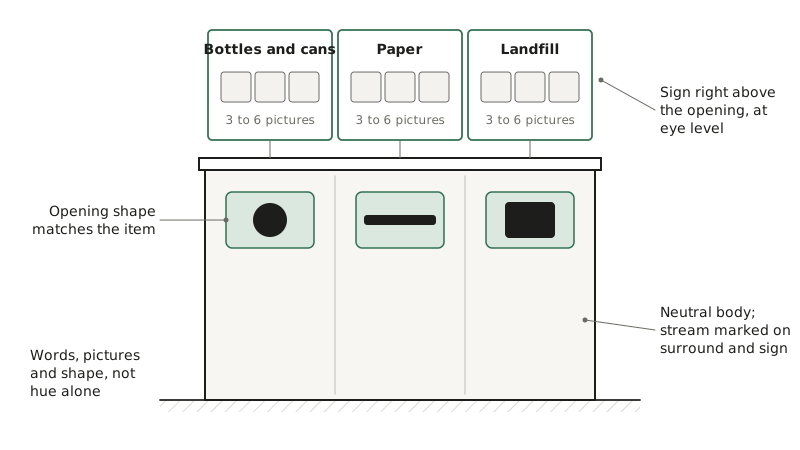
- Do not rely on color alone. Some people have color vision deficiencies, and colors fade outdoors. Pair color with words, icons and opening shapes.
If you want the station body in a brand or site color, use a neutral body and put the stream color on the lid, opening surround or sign panel.
Openings that sort for people
The shape of an opening is a strong hint about what goes in it.
- Round holes for bottles and cans. A hole sized for a drink container makes it awkward to push in a food wrapper or bag.
- Narrow slots for paper and newspapers.
- Wider openings for landfill and organics, which take irregular items.
Keep the same left-to-right order of streams on every station across the site. Regular users learn the pattern and stop reading the signs.
Signage that works in two seconds
Signs on recycling stations often have too many words and too few clear pictures. Effective signs:
- Sit right above or around the opening, at eye level, so people see the sign and the opening together.
- Use a one or two word heading such as "Bottles and Cans" or "Landfill". Avoid jargon such as "commingled".
- Show photos or clear drawings of real items that people on that site actually throw away: the coffee cup from the cafe next door, the drink bottles sold in the vending machine.
- Include the common mistakes where space allows, such as a crossed-out coffee cup lid if lids are not accepted.
- Stay short. Three to six images per stream is usually enough.
- Use high contrast and large lettering so the sign reads from a few steps away.
Consider Spanish or other languages common in your community. Pictures help everyone, whatever language they read. Make signs replaceable, because accepted items change when programs change.
Placement and monitoring
- Place stations where waste is generated: near food vendors, transit stops, entrances and seating.
- Replace standalone garbage bins in busy areas with combined stations, so every bin offers recycling.
- Do a simple waste audit a few weeks after installation. Open a sample of bags and note what is in the wrong stream.
- Use the audit to adjust signs. If coffee cups keep landing in recycling, put a large coffee cup picture on the landfill sign.
- Train crews to keep streams separate during collection. If people see a crew dump both streams into one bag, they stop sorting.
Frequently asked questions
Why is contamination so high in public recycling bins?
People decide quickly, items are often dirty or mixed, and rules differ from place to place. Combined stations, clear pictures and consistent layouts reduce errors, but some contamination is normal. Regular audits show where to improve.
Should we add an organics stream outdoors?
Only where your program accepts it and food waste is common, such as food courts and picnic areas. Organics bins need latched lids and frequent emptying to manage smell, insects and animals.
Can we use our brand colors on recycling stations?
Yes, for the body of the unit. Keep the stream colors on the lids, openings and signs so the sorting cues stay clear and consistent with the local program.