Backed vs Backless Benches
Backless benches suit short stops, open plazas and two-sided seating. Backed benches suit longer rest and older users. Here is how to decide, and how to mix the two.
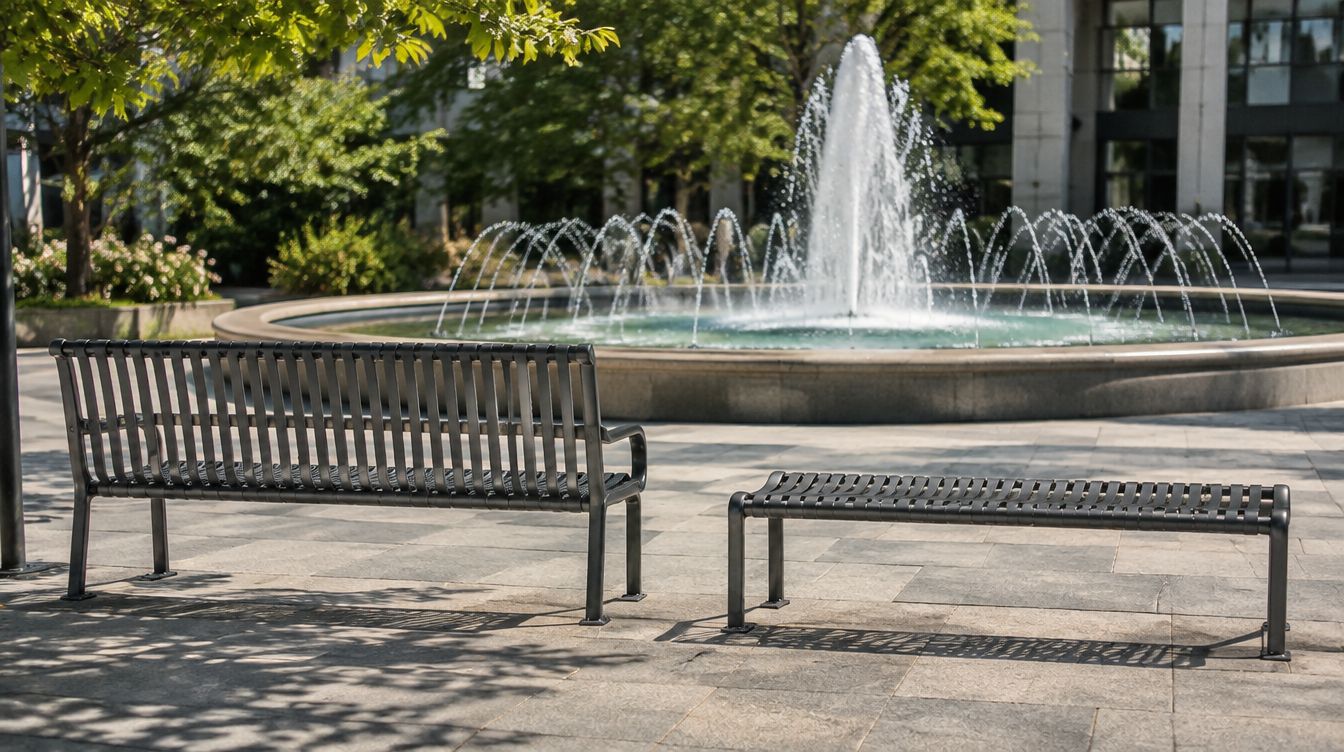
The choice between a backed and a backless bench looks like a style decision, but it changes how long people stay, who can use the seat and how a space feels. A backless bench is open and flexible. A backed bench is supportive and directional. Most sites need both, and the useful question is where each one belongs.
How people use each type
Think about the length of the stay first.
- Short stops of a few minutes: tying a shoe, waiting for a light, checking a phone, eating a quick snack. A backless bench handles these well.
- Medium stays: waiting for a bus, watching children play, eating lunch. Most people start looking for a backrest after ten or fifteen minutes.
- Long rest: older adults on a walk, people recovering their energy, someone reading for an hour. A backrest, and ideally armrests, make the difference between a seat people use and one they avoid.
Backless benches also allow sitting in either direction, straddling the seat and gathering in a loose group. Backed benches orient everyone the same way, toward whatever the bench faces.
Where a backless bench works better
- Plazas and wide open spaces where people approach from all sides and you want seating that does not turn its back on anyone.
- Two-sided locations such as the middle of a promenade, between two play areas, or in a courtyard with activity on both sides.
- Sightline-sensitive spots where a backrest would block views of storefronts, signs or a supervised area. A low backless bench keeps sightlines clear for security and wayfinding.
- Tight corridors where a backrest adds depth the walkway cannot spare. A backless bench is often 100 to 150 mm (4 to 6 in) shallower overall.
- Locker rooms, change areas and gym edges where people sit briefly and need to swing their legs over.
- Next to tables, where a backless bench can slide under or serve both sides.
Backless benches also tend to cost less, ship flatter and have fewer parts to vandalize. Our Backless Bench is a common pick for plazas and building forecourts for these reasons.
Where people need a backrest
- Transit stops and waiting areas, where the wait is unpredictable.
- Parks and trails, especially rest stops along routes used by older people or anyone with limited stamina.
- Near seniors' housing, hospitals and clinics.
- Viewpoints, where people sit to look at water, a garden or a field and stay a while.
- Play areas, where parents watch for long stretches.
Backrests matter for accessibility. People with back pain, balance problems or weak core muscles may not be able to sit upright without support, and a backrest gives them a surface to push against when standing. Accessibility guidance generally recommends back support on at least some seating in every seating area. Whether it is mandatory depends on CSA B651, your provincial rules and municipal standards, so confirm the requirement for your project type.
Design details that change the outcome
| Detail | Backed bench | Backless bench |
|---|---|---|
| Seat height | 430 to 485 mm (17 to 19 in) for both | |
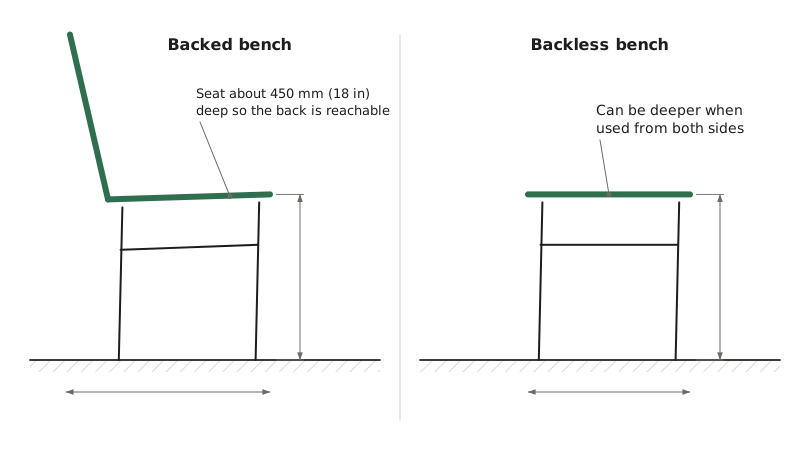
| Seat depth | Around 450 mm (18 in) so the back is reachable | Can be deeper if used from both sides |
| Arms | End arms help people stand | End arms are possible and still useful |
| Typical stay | Long | Short |
| Orientation | One direction | Any direction |
A few points that often get missed:
- Back angle. A slight recline, roughly 100 to 105 degrees from the seat, is comfortable for most people. A bolt-upright back feels like a waiting room chair.
- Back height. The back should support the lower and middle back. A low rail that only hits the hips gives little real support.
- Clearance behind. A backed bench placed against a wall, planter or fence needs room for the back to recline and for cleaning crews to reach behind it.
- Arms on backless benches. A backless bench with end arms is a good compromise in plazas. It keeps the open look while giving people a handhold.
Mixing both types on one site
The strongest layouts give people a choice. A few patterns that work:
- Pairs. Set a backed bench and a backless bench at right angles to each other. Groups can talk face to face, and anyone needing support has it.
- Edges and centres. Put backed benches along the edges of a space, facing in, and backless seating in the open centre.
- Ratio by use. For a park or trail, lean heavily toward backed benches. For a busy downtown plaza, a higher share of backless seating is reasonable, as long as some backed seats remain.
- Same family. Choose backed and backless versions of the same bench design so the site looks consistent and spare parts match.
Common mistakes
- Installing only backless benches in a park because they look cleaner, then hearing from older residents that there is nowhere to rest.
- Putting a backed bench with its back to the main attraction, such as a playground or a view.
- Placing a backed bench in the middle of a plaza, where it reads as a barrier and splits the space.
- Forgetting that a backless bench next to a busy path invites people to sit facing the path, with their feet in the walking route.
- Choosing a backless bench to discourage lying down. It does not work well, and it penalizes everyone else who needs to rest.
Frequently asked questions
Is a backless bench cheaper than a backed bench?
Usually yes, because it uses less material and fewer parts. The saving per bench is modest, though, so let the use of the space drive the decision rather than price alone.
Can I add a back to a backless bench later?
Some designs offer a retrofit back, but many do not, and a field-added back may not match the frame strength. If you think a location might need a back later, order a backed model now.
Do backless benches meet accessibility requirements?
A backless bench at the right height can be part of an accessible site, but most standards and good practice expect some seating with back support. See our guide to accessible benches and seating for the full set of dimensions.