Park Bench Buying Guide
Material, length, backrest, armrests and mounting all shape how a park bench feels and how long it lasts. Settle these decisions before you ask for prices.
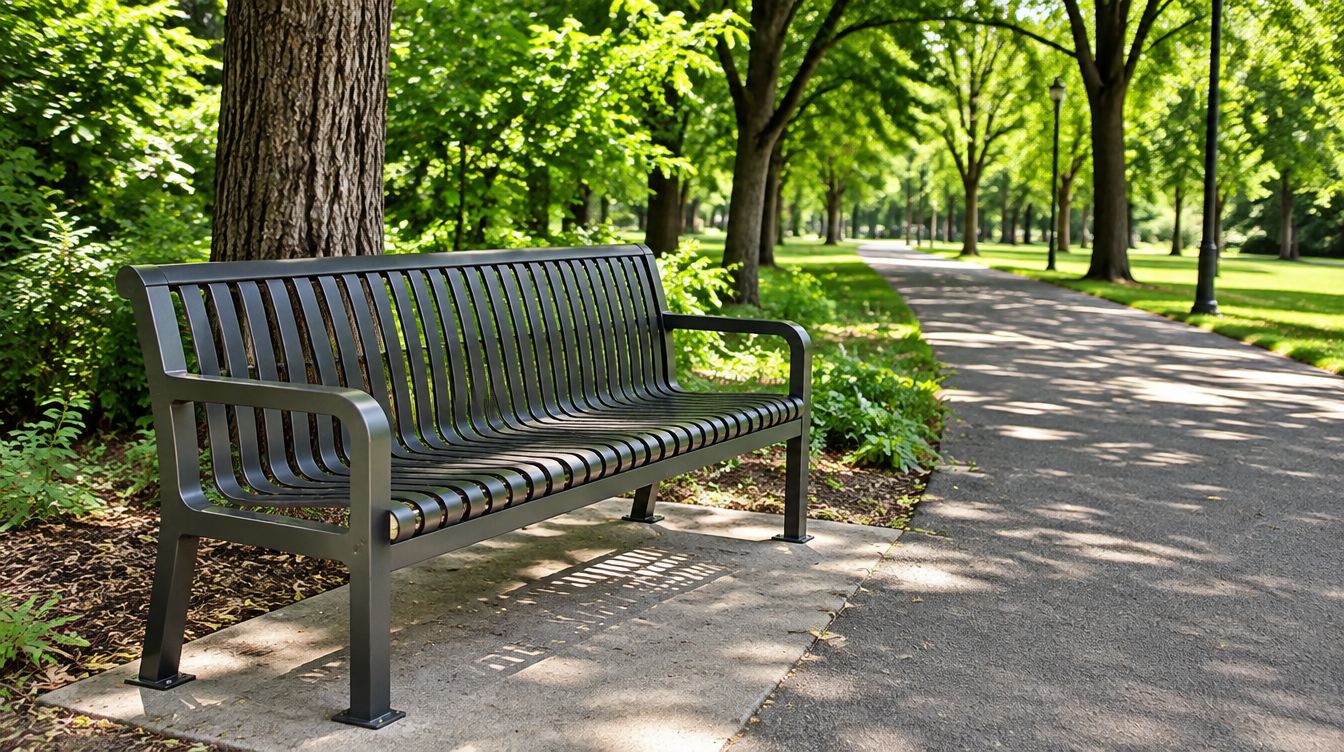
A park bench looks like a simple purchase until you start comparing quotes. One bench costs twice as much as another that looks similar. One has arms, one has none. One bolts down, one sits loose. The right choice depends on who will sit there, how long they will stay, what the site throws at the bench and how much maintenance your crew can give it. This guide walks through each decision in the order that makes sense.
1. Who will use the bench, and for how long?
Start with the people, not the catalogue. A bench along a walking trail is a resting point for a few minutes. A bench in a plaza might hold someone eating lunch for half an hour. A bench at a seniors' residence, hospital or bus stop needs to be easy to sit down on and get up from.
- Short rests and high turnover: backless benches are fine and can be used from both sides.
- Longer stays: a backrest makes a big difference to comfort.
- Older adults and people with limited mobility: choose a backrest and armrests, and pay attention to seat height.
- Areas with skateboarding: intermediate arms or skate deterrents protect the seat edge.
2. Material and finish
Most outdoor benches are steel, wood, recycled plastic or a combination. Each has trade-offs:
| Material | Strengths | Watch for |
|---|---|---|
| Powder-coated steel | Strong, vandal resistant, any colour | Gets hot in sun and cold in winter; needs galvanizing underneath in salted areas |
| Wood on steel frames | Warm to the touch, natural look | Weathers to silver; needs occasional care |
| Recycled plastic | Low maintenance, no splinters | Can sag over long spans; limited colours; can be scratched |
| Stainless steel | Very durable, modern look | Higher cost; shows fingerprints and scratches |
For steel, ask whether the steel is hot-dip galvanized before powder coating. That double layer is the best protection where de-icing salt or sea air is present. For wood, look for durable species or thermally modified wood that resists rot without chemical treatment. Our bench materials guide goes deeper.
3. Size and dimensions
Common bench lengths are 1.2 m, 1.8 m and 2.4 m (4, 6 and 8 ft). A 6 ft bench seats three adults comfortably, which suits most parks and streetscapes. Longer benches are good for plazas and waterfronts but are more likely to need a centre support and a centre arm.
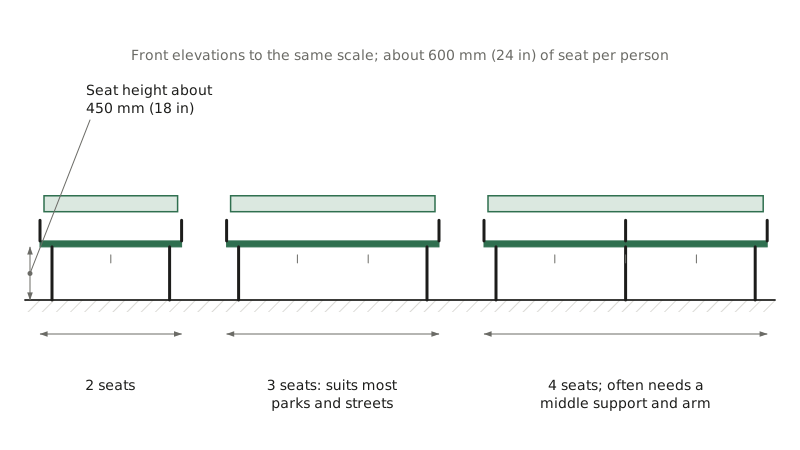
Key dimensions to check on any drawing:
- Seat height: about 450 mm (18 in) above the ground suits most adults. Much lower is hard to get up from; much higher leaves feet dangling.
- Seat depth: deep enough to sit back, but not so deep that shorter people cannot reach the backrest with their feet on the ground.
- Back angle: a slight recline is more comfortable than a bolt-upright back.
- Armrest height: high enough to push up from, typically a little above the seat at elbow height when seated.
4. Backs, arms and accessibility
Backrests and armrests are not just comfort features. For many older adults and people with disabilities, they decide whether a bench is usable at all. Armrests give leverage to stand up and help people judge where the seat is.
Accessibility requirements for public seating vary by jurisdiction. In Canada, CSA B651 and provincial rules such as Ontario's AODA Design of Public Spaces standard address seating along routes and in rest areas. Requirements include things like clear ground space beside benches for people using wheelchairs or mobility aids, and features such as backrests and armrests on a portion of benches. Confirm the details with your municipality or province.
A practical approach is to make most benches on a site backed with armrests, and use backless benches where short stays are expected. Our accessible seating guide covers this in detail.
5. Mounting
- Freestanding: heavy benches simply placed on the surface. Flexible for events and patios, but they can be moved or stolen in unsupervised areas.
- Surface mount: bolted to a concrete pad with tamper-resistant anchors. The most common choice for parks and streets.
- In-ground: legs set into concrete footings. Very secure and suits benches on grass or soft surfaces, though removal is harder.
Benches on grass need a hard pad underneath and in front, or the ground turns to mud and the legs sink. Make the pad large enough to include the clear space beside the bench for a wheelchair or stroller.
6. Budget, lead time and lifetime cost
Compare benches on lifetime cost, not purchase price. A cheaper bench that needs repainting every few years, or has slats that crack, costs more over twenty years than a well-built one. When you request quotes:
- Specify the finish system, not just the colour: galvanizing, pretreatment and powder coat type.
- Ask for fastener material. Stainless fasteners avoid rust stains.
- Ask whether replacement slats and parts are available.
- Confirm lead time. Our standard benches ship in about two weeks; custom finishes and shapes take longer.
- For public purchases, follow your municipal procurement bylaw and any trade agreement thresholds.
Our range includes the Flat Bar Bench in steel and the Timber Slat Bench with thermally modified ash, both with a seat height of 450 mm (18 in).
Frequently asked questions
What is the standard height of a park bench?
Seat heights of about 430 to 480 mm (17 to 19 in) are typical, with 450 mm (18 in) a common target. Check any accessibility requirements that apply to your site.
Should park benches have armrests?
Many should. Armrests help people sit down and stand up and make benches usable for more people. Centre arms also discourage skateboarding along the seat. Some benches without arms are still useful where people sit from both sides.
Do benches need to be anchored?
In most public spaces, yes. Anchoring prevents theft, stops benches being moved into walkways and keeps them from tipping. Freestanding benches suit supervised areas and patios.