Planning Bike Parking Capacity
How many bike spaces does a site need? Start with local requirements, then check them against real demand, peak times and room to grow.
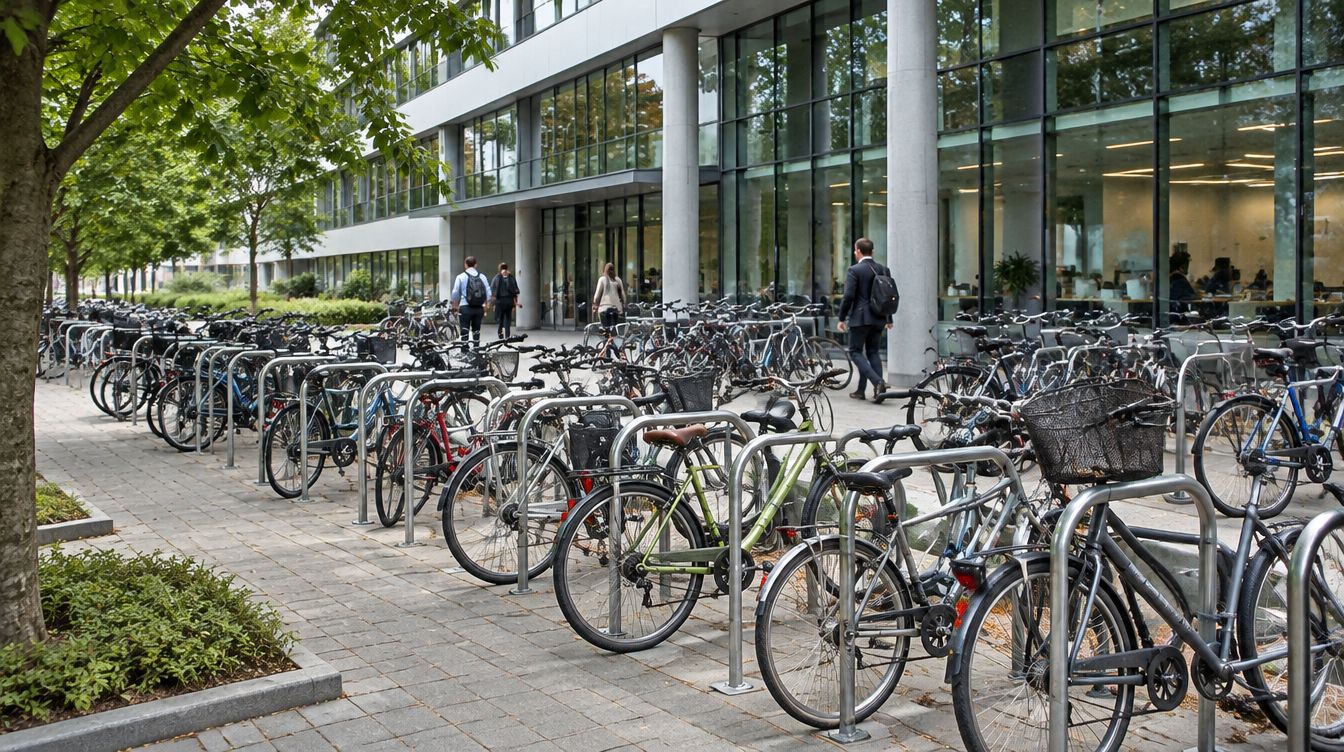
The most common bike parking problem is not a bad rack. It is too few racks. When parking fills up, cyclists lock to railings, trees and benches, and the site looks cluttered even though the owner did install bike parking. The opposite mistake also happens: a long row of racks at a location where nobody arrives by bike. Good capacity planning sits between those extremes. It uses local rules as a floor, real demand as a check and a sensible margin for growth.
Step 1: Find the minimum you are required to provide
Many municipalities set minimum bike parking in their zoning bylaws or site plan guidelines. Requirements are usually expressed as a rate tied to the size or use of the building, such as spaces per dwelling unit, per square metre of floor area, per classroom or per number of employees. They often split the total into short-term (visitor) and long-term (resident or employee) spaces.
Rates vary widely between cities and change as policies are updated, so there is no single national number to rely on. In Canada, check the municipal zoning bylaw and any site plan or urban design guidelines. Some larger cities have detailed bike parking standards; smaller towns may have none. Where no requirement exists, you still need a number, so move on to estimating demand.
Step 2: Estimate real demand
A demand estimate answers a simple question: at the busiest normal time, how many bikes will be parked at once? The basic calculation is:
- Estimate the number of people on site at the peak (employees, students, residents, customers or visitors).
- Multiply by the share who arrive by bike, or the share you aim for. Use local travel surveys, a count at a similar site, or a target from a transportation plan.
- Adjust for turnover. Short visits mean one space serves several cyclists over a day, but you are sizing for the busiest moment, not the daily total.
- Add a margin for growth, events and good weather days.
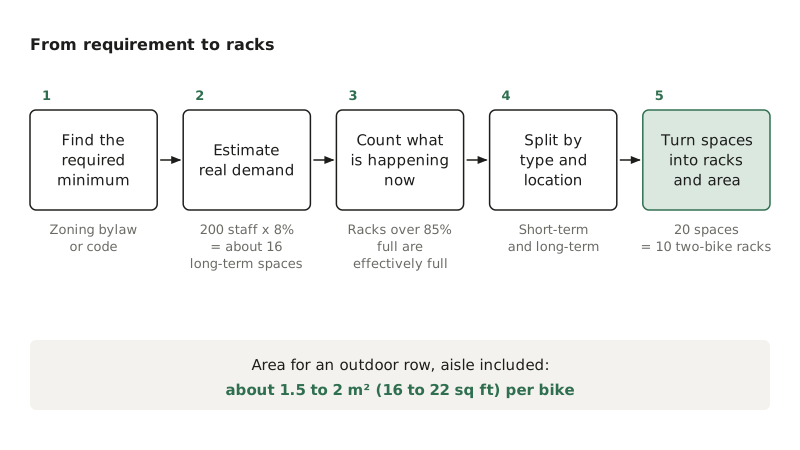
For example, an office with 200 staff on site and an expected bike share of 8 percent needs about 16 long-term spaces at peak. If you plan to grow cycling with better facilities, size for the target, not today's numbers. Parking that is secure and convenient tends to attract riders who did not cycle before.
Step 3: Count what is happening now
If the site already exists, a few counts beat any formula. Walk the site at the busiest times on a few fair-weather days and record:
- Bikes parked at existing racks.
- Bikes locked to anything that is not a rack: railings, signs, trees, benches.
- Abandoned bikes that are occupying spaces.
- Where the bikes cluster, since demand is usually concentrated at one or two entrances.
Bikes locked to fixtures are the clearest sign of unmet demand. As a rule of thumb, if racks are regularly more than about 85 percent full, they are effectively full, because people cannot find the last few spaces or cannot fit into them.
Step 4: Split by type and location
A total number is only part of the answer. Divide it by who parks and for how long:
- Short-term visitor parking: racks close to each main entrance, in view, and spread across entrances rather than lumped in one place.
- Long-term parking: sheltered and secure parking for employees, residents and students who leave bikes for hours or overnight.
- Specialty spaces: a few spaces with extra length or width for cargo bikes, trailers, tricycles and adaptive bikes.
- E-bike charging: if demand is likely, plan a few long-term spaces near power outlets, following the electrical code and the building owner's fire safety rules.
A useful planning habit is to place at least a small cluster of racks at every public entrance, then concentrate the remaining capacity where most cyclists actually arrive.
Step 5: Translate spaces into racks and area
Once you know the number of spaces, convert it to racks and floor area. Two-sided inverted-U and ring racks hold two bikes each when spaced properly, so 20 spaces means 10 racks. Allow for the full bike length on each side and an access aisle. A rough planning figure for an outdoor row of racks, including the aisle, is around 1.5 to 2 m² (16 to 22 sq ft) per bike. Tighter layouts are possible with angled or rail-mounted racks; more generous ones are better for busy sites.
Our spacing and layout guide gives the clearances to use when you draw the plan.
Typical demand drivers by site type
| Site | What drives demand | Planning note |
|---|---|---|
| Office or workplace | Number of staff on site, shower and locker access | Mostly long-term, plus a few visitor racks |
| Apartment building | Number of units, size of units | Secure indoor storage matters most |
| School | Number of students, grades, distance students live from school | Big morning peak, plan for growth |
| Retail and restaurants | Customer turnover, nearby bike routes | Short-term, close to doors |
| Park or trailhead | Events, weekends, weather | Seasonal peaks, consider rail-mounted extras |
| Transit stop or station | Ridership, catchment area | Mix of quick racks and secure all-day parking |
Plan for growth and peaks
Bike parking demand rarely stays flat. New bike lanes, a bike share station, a new building wing or a school program can all raise demand quickly. Plan for it:
- Reserve space on the plan for future racks and run conduit for future lighting or charging.
- Use surface-mounted or rail-mounted racks for overflow areas so they can be added or moved easily.
- For events, use temporary rail-mounted racks or a staffed bike valet rather than permanent racks that sit empty most of the year.
- Recount a year after opening and add racks where they are full.
Our standard racks ship in about two weeks, so adding capacity after a recount is a quick job. Contact us through the contact page if you would like help turning a demand estimate into a layout.
Frequently asked questions
Is there a standard number of bike spaces per building?
No single standard applies everywhere. Most requirements come from municipal zoning and vary by city and land use. Check the local rules first, then compare them with a demand estimate and use the higher figure.
Should I count bikes in winter?
Count in fair weather so you size for the busy season. Winter counts still help if you are deciding how many racks must be cleared of snow, since year-round riders need that parking kept usable.
What if I have more spaces than are being used?
Check that the racks are in the right place first. Parking hidden behind a building or far from the door often sits empty while bikes are locked to railings at the entrance. Moving racks usually fixes it.