Short-Term vs Long-Term Bike Parking
Visitors need quick racks near the door. Employees and residents need secure, sheltered parking for hours or overnight. Plan both, because one cannot replace the other.
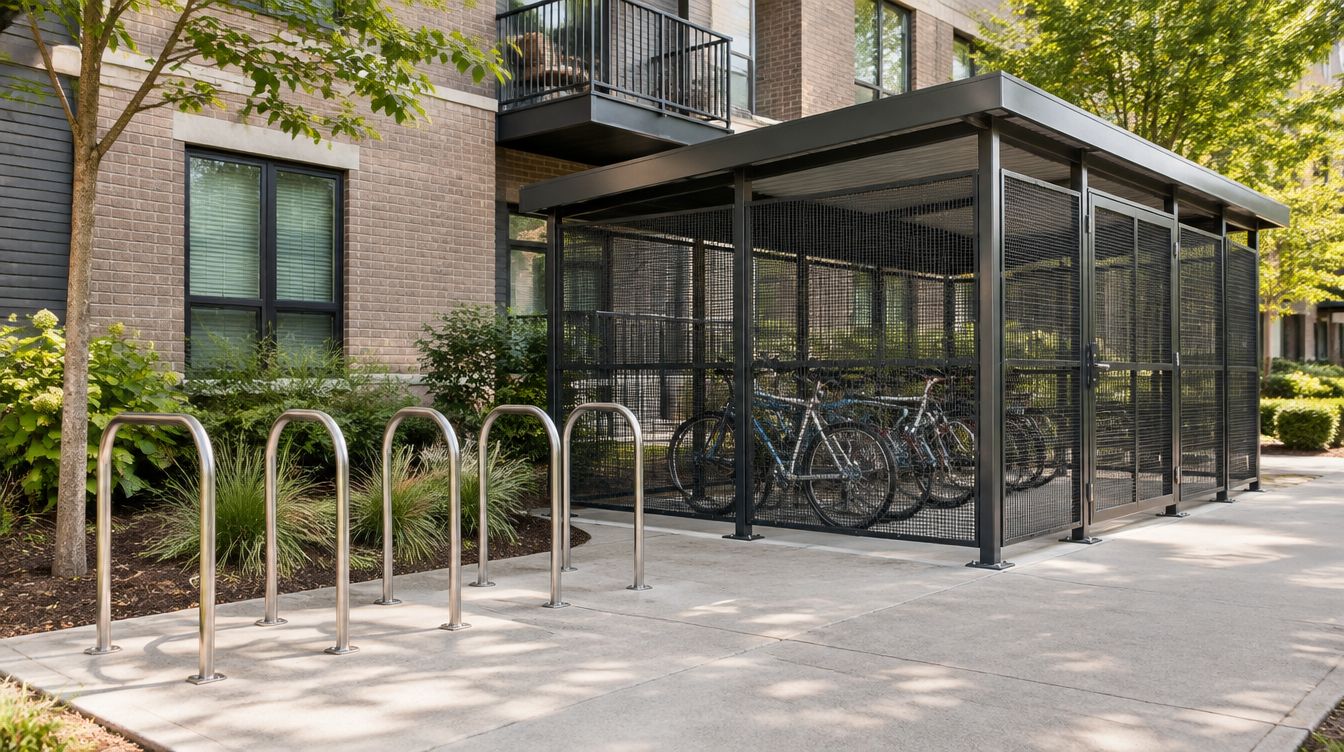
A shopper who stops for twenty minutes and a nurse who parks for a twelve-hour shift want very different things from bike parking. The shopper wants a rack by the door. The nurse wants to know the bike will be dry, whole and still there at the end of the shift. Planners call these short-term and long-term parking. Most buildings need both, and getting the split right is the difference between parking that is used and parking that is ignored.
What counts as short-term and long-term
The usual dividing line is about two hours. The definitions below are common practice rather than a fixed rule, and local zoning may define them differently.
| Short-term | Long-term | |
|---|---|---|
| Typical stay | Up to about two hours | Several hours, a workday or overnight |
| Typical users | Customers, visitors, delivery riders | Employees, residents, students, commuters |
| Priority | Convenience and visibility | Security and weather protection |
| Typical form | Outdoor racks near entrances | Bike rooms, cages, lockers, sheltered compounds |
| Access | Open to anyone | Restricted to authorized users |
Designing short-term parking
Short-term parking succeeds or fails on location. If it is not closer and easier than the nearest railing, people will use the railing.
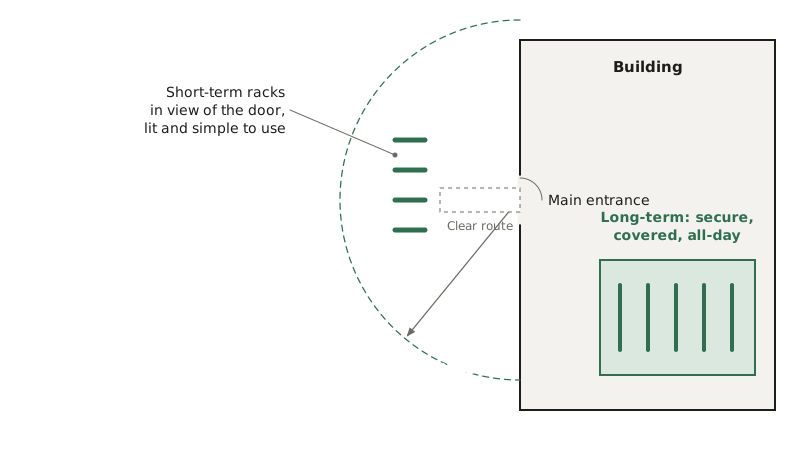
- Close to the door. Place racks within sight of the main entrance and as close as practical. A common target is within about 15 m (50 ft) of the entrance it serves. If a building has several entrances, split the racks among them.
- Visible. Racks in view of the door, the street or a window are used more and get fewer thefts.
- Lit. Many short visits happen after dark in winter.
- Simple. Use racks that anyone can figure out at a glance, like inverted-U or ring racks.
- Clear of the walkway. Bikes must not block the accessible route to the entrance. Check CSA B651 and provincial accessibility rules.
Shelter is a nice addition for short-term parking but not essential. A building canopy or a small roof over a few racks is welcome on rainy days.
Designing long-term parking
Long-term users trade a slightly longer walk for peace of mind. They will accept parking inside a garage or a secure room if it protects their bike. What they need:
- Security. Access controlled by key card, fob or code, with only authorized users inside. Even inside a locked room, each bike still needs a rack to lock to, since theft by other users does happen.
- Weather protection. Full shelter from rain and snow. A bike left outside every day for a winter of salt and slush will corrode quickly.
- Easy access. A step-free route from the street, wide doors, and ideally automatic or easy-open doors. Avoid routes through stairwells or narrow corridors, and avoid long ramps without a level landing.
- Floor-level spaces. Vertical hooks and two-tier racks save space, but many people cannot lift heavy bikes, especially e-bikes. Keep a good share of spaces at floor level.
- Room for larger bikes. Include some spaces for cargo bikes, trailers and adaptive bikes.
- Power where needed. Outlets for e-bike charging, planned with the building's electrical and fire safety requirements in mind.
- Supporting amenities. At workplaces, showers, changing rooms and lockers make cycling to work realistic for many more people.
Options for long-term parking
- Bike rooms: a secure room in the building, fitted with racks. Efficient for offices and apartments.
- Bike cages or compounds: a fenced, roofed enclosure in a parking garage or outside. Good where indoor space is short.
- Bike lockers: individual enclosed boxes, rented or assigned. Very secure, but each one takes more space than a rack, and lockers can sit empty if users stop renewing.
- Covered outdoor racks with surveillance: a compromise where a secure room is not possible. Acceptable for daytime parking at schools and workplaces, less so overnight.
Getting the split right
Many zoning bylaws set separate minimums for short-term and long-term spaces based on building use. Where they do not, think about who arrives and how long they stay:
- Apartments and condominiums: mostly long-term for residents, plus a few visitor racks at the entrance.
- Offices: mostly long-term for employees, plus short-term racks for visitors and couriers.
- Retail, restaurants and libraries: mostly short-term, with a small secure area for staff.
- Schools and campuses: both, often with covered racks in a supervised area serving as long-term parking during the day.
- Transit stations: both, since some riders park for a few minutes and others leave a bike all day.
Our capacity planning guide walks through estimating the total number of spaces.
Common mistakes
- Treating outdoor visitor racks as long-term parking. Employees will park there, but bikes left all day outdoors are more exposed to theft and weather.
- Putting the bike room at the far end of the parking garage, behind three doors.
- Filling the bike room with wall hooks only.
- Forgetting a rack inside secure rooms, leaving bikes leaning on walls with no way to lock them.
- Placing short-term racks around the back of the building, out of sight.
Racks such as our Loop Rack work in both settings: surface mounted by an entrance for visitors, or rail mounted in rows inside a bike room.
Frequently asked questions
Can covered outdoor racks count as long-term parking?
Sometimes. Some local rules accept sheltered racks in a supervised or access-controlled area as long-term parking, while others require an enclosed, locked space. Check your zoning requirements.
How secure does long-term parking need to be?
Enough that only authorized users can get in, with a rack inside for each bike. Add lighting, a clear view through the door and, where theft is a concern, cameras.
Are bike lockers better than a bike room?
Lockers offer the highest individual security and suit sites with scattered demand, such as transit stations. Bike rooms are more space-efficient for buildings with many regular users.