Reducing Bike Theft at Racks
Most bike theft is opportunistic. The right rack, firm anchoring, good placement and lighting make bikes at your site harder targets than the ones down the street.
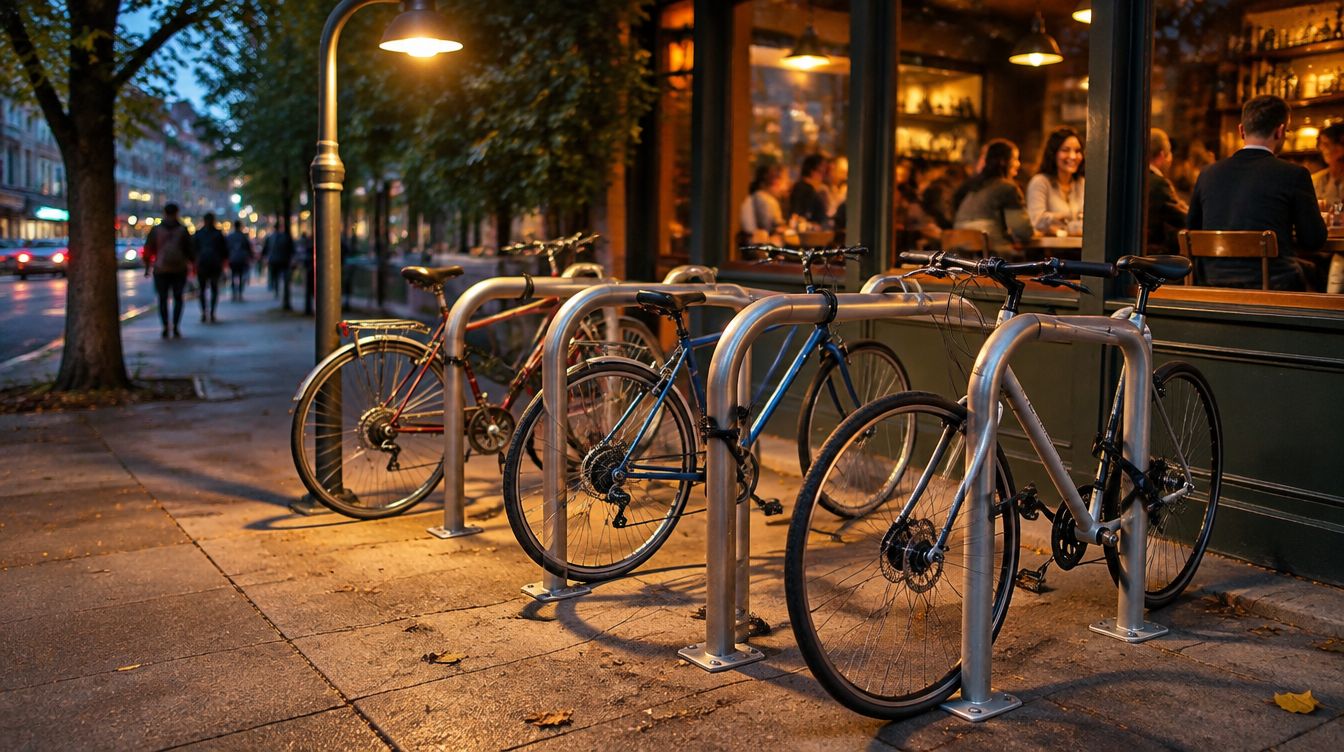
No rack makes a bike impossible to steal. A determined thief with a battery angle grinder can cut through almost anything given enough time. But most bike theft is quick and opportunistic: a thin cable lock, a rack that unbolts, a quiet corner with nobody watching. Property owners cannot control which lock a cyclist uses, but they can control the rack, how it is anchored, where it sits and who can see it. Those choices make a real difference to how often bikes at a site go missing.
How bikes get stolen from racks
Understanding the common methods points straight to the fixes:
- Cutting the lock. Cable locks are the easiest target. U-locks and heavy chains take more time and noisier tools.
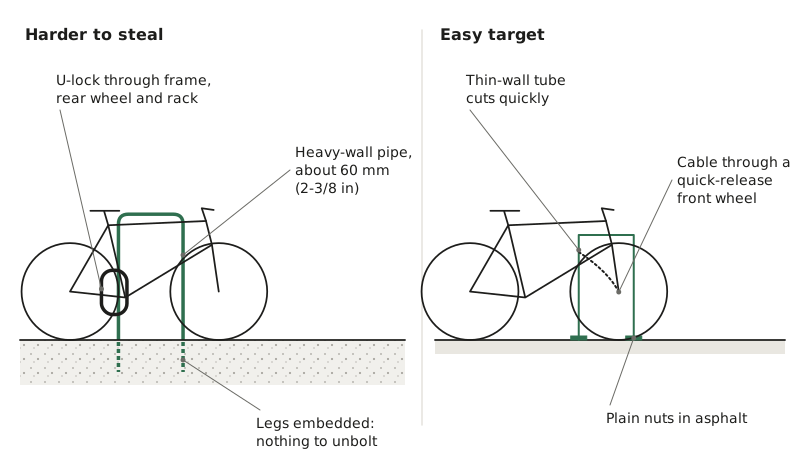
- Cutting the rack. Thin-wall tube can be cut with a pipe cutter or a hand saw, freeing every bike locked to it. A thief may cut a rack in advance and tape it back together, then wait for a good bike.
- Removing the rack. Racks held down by ordinary nuts, or anchored into soft asphalt, can be unbolted or pried up and the bikes slid off.
- Lifting the bike over the rack. Short sign posts and low racks let a locked bike be lifted off the top.
- Stripping parts. Wheels, seats and batteries held by quick-release fittings disappear even when the frame stays locked.
Choose a rack that resists attack
The rack is the part of the system the owner controls fully, so make it the strongest link.
- Solid, heavy-wall steel. Schedule 40 steel pipe around 60 mm (2-3/8 in) outside diameter is a common choice. It takes a lot longer to cut than thin tube, while still being slim enough for a standard U-lock.
- Two points of contact. A rack that supports the frame lets the cyclist lock the frame and a wheel together. Wheel-only racks encourage locking just the wheel, and thieves simply take the rest of the bike.
- No removable parts. Avoid racks assembled from pieces that bolt together above ground. Welded, one-piece construction removes weak points.
- Closed shapes. A loop or ring with both ends anchored cannot be lifted over. Single posts need a cap or ring that stops a lock sliding off the top.
Anchor it properly
A strong rack on weak anchors is a weak rack. For surface-mounted racks:
- Fix into sound concrete only. Never into asphalt or pavers without a concrete footing.
- Use tamper-resistant fasteners: security nuts, one-way heads or caps that need a special tool.
- Consider spot-welding nuts or using anchors that cannot be backed out once set, for high-risk sites.
- For the highest security, embed rack legs in concrete. There is nothing to unbolt.
Rail-mounted sets should be anchored too. A freestanding rail set holding several bikes can be carried off by a small group. Our installation guide covers each method.
Place racks where people can see them
Thieves prefer privacy. Racks in busy, visible locations are targeted less than racks in quiet corners. This is the idea behind crime prevention through environmental design (CPTED), which many municipalities and police services promote.
- Natural surveillance. Put racks in view of entrances, windows, staffed desks, patios and the street. A rack visible from a busy café is safer than one behind a hedge.
- Keep sightlines open. Avoid placing racks behind dumpsters, tall planters, dense shrubs or solid walls.
- Close to the door. Short-term racks right by the entrance are more convenient and more watched. Our short-term and long-term parking guide explains why.
- Avoid isolated rows. A long row of racks at the edge of a parking lot gives a thief time and cover.
Light it well
Good lighting helps cyclists lock up after dark and lets passersby see what is happening at the rack. Aim for even lighting across the whole parking area, without dark pockets between fixtures. Light both the rack and the approach path. If cameras are installed, check that the lighting is good enough for them to produce a usable image at night. Ask an electrical designer to set light levels to suit the site and local standards.
Secure parking for long stays
Bikes left all day or overnight face far more risk than bikes left for half an hour. For employees, residents and transit users, provide secure long-term parking such as a locked bike room, an access-controlled cage or individual lockers. Inside, still provide a rack for every bike. Thefts inside shared bike rooms are not rare, and an unlocked bike in a shared room is easy to walk out with.
Manage the site and help cyclists
- Remove abandoned bikes on a set schedule, after tagging them with a notice. Stripped bikes left on racks signal that nobody is watching.
- Inspect racks during routine maintenance for cuts, tape, loose anchors or tampered fasteners.
- Post simple advice near the racks: use a U-lock through the frame and a wheel, take lights and batteries, and register the bike's serial number.
- Work with local police or campus security. Many run bike registration programs and can advise on hot spots.
- Respond to reports. If thefts cluster at one rack, move it, light it better or add surveillance.
Frequently asked questions
What is the most theft-resistant bike rack?
A one-piece rack made from heavy-wall steel pipe, supporting the frame at two points, with legs embedded in concrete or fixed with tamper-resistant anchors. Shape matters less than material, anchoring and placement.
Do cameras stop bike theft?
Cameras can deter some thefts and help investigations, but they work best combined with good lighting, visible placement and a sturdy rack. A camera aimed at a dark corner does little.
Can we make cyclists use better locks?
You cannot require it at public racks, but you can encourage it. Post simple advice, support registration programs, and design racks that fit U-locks easily. Some workplaces and schools hand out discounted U-locks during bike events.