Bollard Types Explained
Bollards range from decorative posts that guide traffic to engineered barriers tested against trucks. This guide sorts out the main types, what each one really does and how to pick the right one for your site.
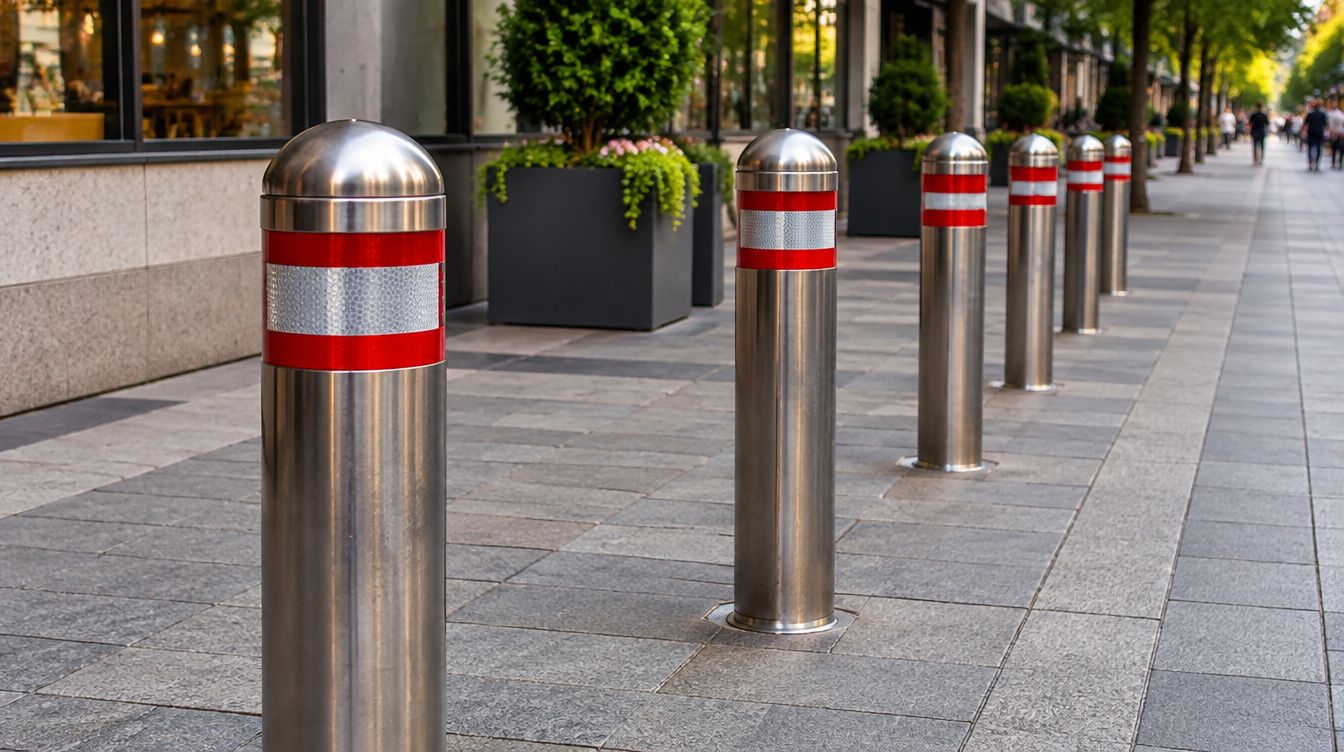
"Bollard" covers a wide range of products. A cast aluminum post at a park entrance and a steel barrier at an embassy share a name and a rough shape, but they do very different jobs. Choosing well starts with being clear about the job. Do you need to show drivers where not to go, physically stop a car that is creeping forward, or stop a vehicle at speed? The answer narrows the choice quickly.
Start with the purpose
Most bollards fall into one of three roles:
- Guidance. The bollard marks an edge, defines a path or tells drivers where a lane ends. It works because drivers see it and choose not to hit it.
- Low-speed protection. The bollard stops or slows a vehicle moving slowly, such as a car parking against a storefront or a truck backing up to a loading dock. How well it does this depends on the post, the footing and the soil.
- Security. The bollard is part of an engineered system designed and tested to stop a vehicle of a known weight at a known speed. These are crash rated and sit on deep, engineered foundations.
Most bollards sold for streetscapes, parks and campuses are guidance or low-speed products. They are not designed to stop a vehicle driven at speed, and should not be relied on for that. If you need that level of protection, read our guide to crash-rated versus non-rated bollards.
The main types
| Type | How it works | Typical use |
|---|---|---|
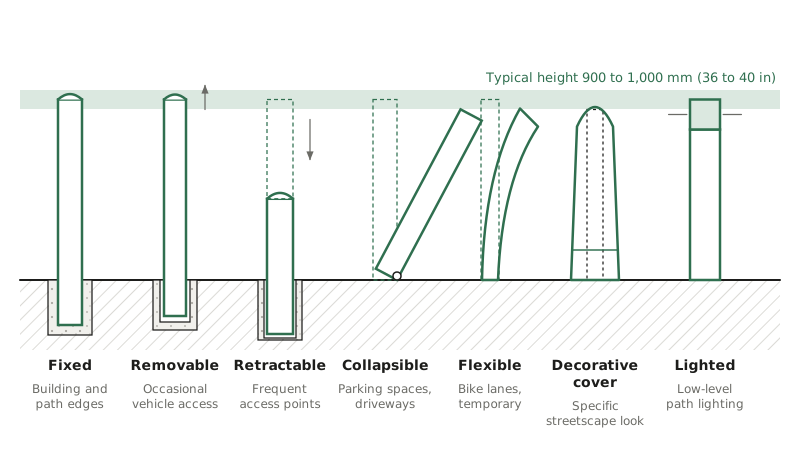
| Fixed | Permanently embedded in concrete or bolted to a slab | Building edges, path edges, protecting equipment |
| Removable | Lifts out of a ground sleeve and locks in place | Lanes that need occasional vehicle access |
| Retractable | Lowers into the ground, often with spring or gas assist | Frequent access points where lifting is impractical |
| Collapsible | Hinges at the base and folds flat when unlocked | Parking spaces, driveways |
| Flexible | Plastic or rubber post that bends when struck and springs back | Bike lanes, temporary traffic separation |
| Decorative cover | Cast or fabricated shell placed over a steel pipe or core | Streetscapes that need a specific look |
| Lighted | Includes a light fixture in the head | Paths and plazas that need low-level lighting |
| Crash rated | Engineered and tested system with deep foundation | Government, high-risk crowded spaces |
Fixed bollards
Fixed bollards are the most common type. They come in two main mounting styles. An embedded bollard sits in a concrete footing below grade, which gives it far more resistance to impact. A base-plate bollard bolts to an existing concrete slab, which is quicker and avoids digging, but it is mainly a visual barrier. A car can shear the anchors or crack the slab. Our Fixed Bollard can be supplied in either style.
Many fixed steel bollards are filled with concrete after installation. Filling adds mass and stiffness, though the footing still does most of the work.
Removable, retractable and collapsible bollards
These types solve the same problem: keeping vehicles out most of the time while letting authorized vehicles through. They differ in how much effort each opening takes.
- Removable bollards are the simplest and cheapest. A worker unlocks the post, lifts it out and stores it, leaving a flush cover at grade. They suit access needed weekly or less. See our Removable Bollard.
- Retractable bollards drop down into a housing in the ground. Nothing needs to be lifted or stored, so they suit more frequent access. The housing needs drainage, and debris and ice can cause problems.
- Collapsible bollards fold down on a hinge. They are quick to operate, but the folded post sits on the surface where it can be a trip hazard or get hit by plows.
All three are weaker than a fixed embedded bollard of similar size, because the post is not locked into concrete. Treat them as access control, not protection.
Flexible, decorative and lighted bollards
Flexible posts are traffic delineators. They separate lanes and mark edges, and they survive being hit because they bend. They do not stop vehicles.
Decorative bollards are about appearance. A cover can sit over a steel core to add strength, so check what is inside. A hollow cast shell on its own offers little resistance to a vehicle.
Lighted bollards add path lighting at a low height. They need wiring and an electrician, and are usually less robust than plain steel posts, so keep them back from areas where vehicles might hit them.
How to choose
- Write down the threat in plain words, for example "cars rolling into the patio while parking" or "delivery vans cutting across the plaza".
- Decide whether vehicles ever need to pass. If yes, choose removable, retractable or collapsible for those positions.
- Check what is under the surface before choosing embedded or base-plate mounting.
- Set spacing so vehicles cannot pass but people using wheelchairs, strollers and bikes can.
- Match the finish and color to other furniture, and make sure the bollards contrast with the paving for people with low vision.
- If the risk is a deliberate attack or a vehicle at speed, bring in a security consultant and specify crash-rated products.
Frequently asked questions
What height should a bollard be?
Most site bollards are roughly 36 to 40 in (900 to 1,000 mm) tall. That is high enough for drivers to see from the seat and for people to notice while walking. Very short bollards are easy to trip over or miss.
Are concrete-filled bollards crash rated?
Not by default. A crash rating applies to a specific tested design, foundation included. Filling a pipe with concrete makes it stiffer but does not give it a rating.
Can I add a bollard cover to an existing pipe bollard?
Yes. Covers slide over common pipe sizes and can refresh old yellow pipe bollards. Measure the outside diameter and height of the existing pipe first.