Removable Bollards for Emergency and Service Access
Removable bollards close a lane or plaza to everyday traffic while letting fire trucks, ambulances and maintenance crews through. This guide covers locking options, fire access, receivers, winter use and who holds the keys.
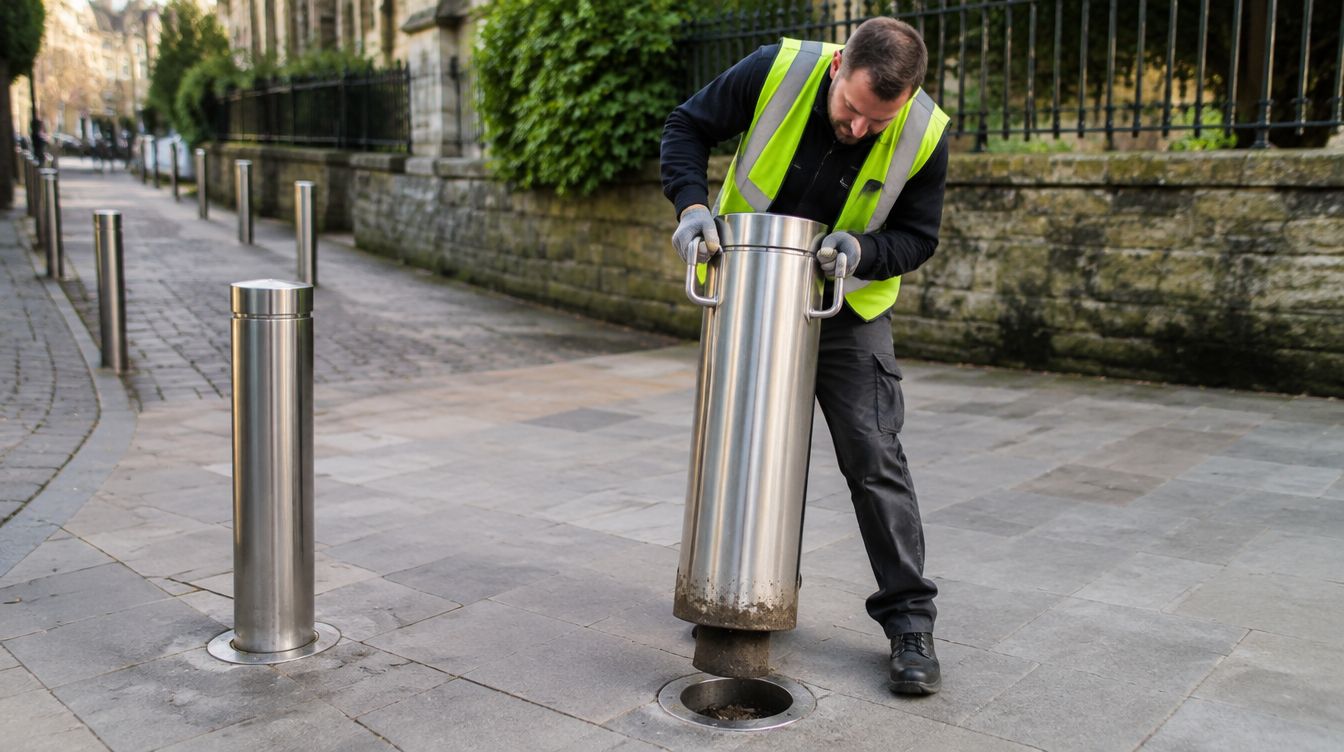
Many spaces need to be closed to cars most of the time but open to some vehicles some of the time. A pedestrian lane may need fire truck access. A park path may need a maintenance truck once a week. A market street may close only on weekends. Removable bollards handle all of these cases at low cost. They only work, though, if the right people can open them quickly, and if the receivers in the ground are built to survive traffic, water and winter.
How removable bollards work
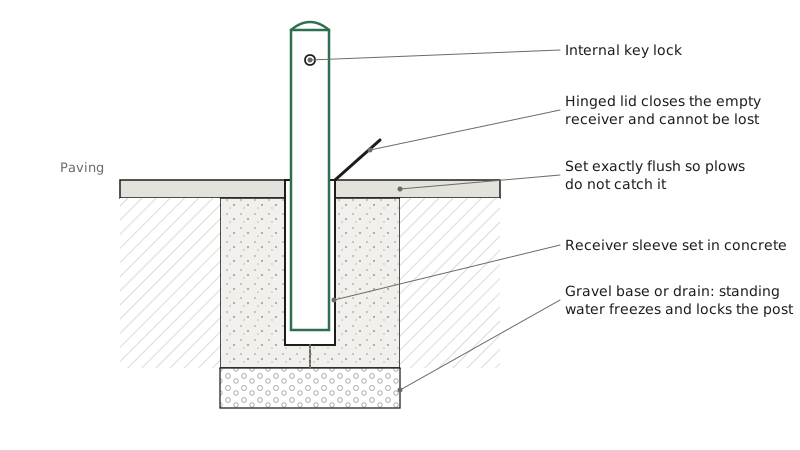
A removable bollard has two parts. A receiver, or sleeve, is set in concrete flush with the paving. The bollard post drops into the receiver and locks. To open the route, someone unlocks the post, lifts it out and either stores it nearby or carries it away. A cover or flush lid closes the empty receiver so it is safe to walk and drive over.
The main variations are:
- Locking method. Options include an internal lock operated by a key, a padlock through a hasp, or a lock using a special tool such as a triangle key. Internal locks look cleaner and are harder to tamper with.
- Receiver cover. Some receivers have a hinged lid that flips closed. Others use a separate plug. A hinged lid cannot be lost.
- Lifting aids. Heavier bollards may have a handle or lifting point. Telescoping types lower into the ground with spring assist, so nothing has to be carried.
Plan fire and emergency access first
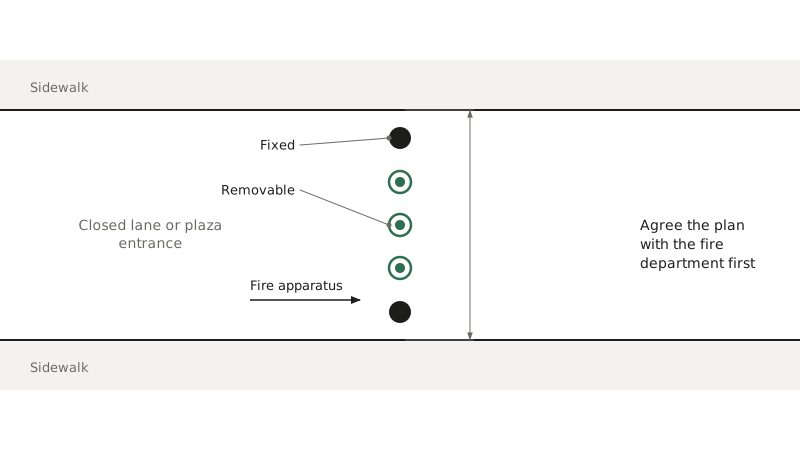
If the closed route is a fire access route, the fire department has a say in how it is closed. Fire apparatus access roads are regulated by the International Fire Code as adopted by your state or city, along with local amendments. Access roads are commonly required to be at least 20 ft (6 m) wide. Requirements vary, so meet the local fire department early and ask:
- How wide must the opened gap be, and how many bollards need to come out to provide it?
- What lock or key system do crews carry? Many departments prefer a specific key or tool, or a breakaway padlock they can cut.
- How quickly must the route be opened, and who will open it during the night?
- Are turning radii and overhead clearance adequate once the bollards are removed?
Get the answers in writing and put them on the drawings. A fire crew stuck behind a locked bollard they have no key for is the failure you most need to prevent.
Locking and key control
Key control is where removable bollards go wrong over time. Keys get lost, staff change and contractors keep copies.
- Use a single key or lock type for all removable bollards on a site, so crews are not hunting for the right one.
- Keep a register of who holds keys, including the fire department, maintenance staff and any event operators.
- Choose a lock that tolerates water, grit and freezing. Exposed padlocks rust and seize. Internal locks with drainage hold up better.
- Check locks on a schedule, not just when someone needs to open the route.
Receivers, drainage and winter
The receiver is the part that lives in the ground year round, and it takes the most abuse.
- Drainage. Water collects in an open or covered receiver. Set the receiver on a gravel base, or drain it, so water does not sit inside. Standing water freezes, locks the bollard in place and can crack the surrounding concrete.
- Debris. Sand, salt, leaves and litter fill empty receivers. A hinged or tight-fitting lid keeps them cleaner. Clean receivers out before reinstalling bollards.
- Plows. A lid that sits even slightly proud of the surface will be hit by plows. Set receivers exactly flush, and check that the surrounding paving does not settle.
- Traffic loads. If vehicles drive over the empty receivers, the receiver and its lid must be rated for that load. Ask the supplier.
In snowy regions, many owners pull removable bollards for the winter so plows can clear the full width. If you do, plan where the bollards will be stored and when they will go back in.
Weight and handling
A removable bollard that is too heavy will not be removed, or it will be dropped and damaged. Ask for the post weight before you buy. Steel bollards suit most sites, with a weight one worker can lift safely. Avoid filling removable posts with concrete. Where posts must be heavy, choose a telescoping or retractable type so no one has to carry them.
Keep a storage spot close by. A nearby rack or a locked storage area saves trips and reduces lost bollards. Number each post and receiver if posts are matched to particular receivers.
Removable bollards versus other options
| Option | Best for | Trade-off |
|---|---|---|
| Removable bollard | Access needed weekly or less | Manual lifting and storage |
| Telescoping or retractable | Daily or frequent access | Higher cost, needs drainage and upkeep |
| Gate or swing arm | Very frequent vehicle access | Looks more like a road closure |
| Movable planters | Seasonal or event closures | Need equipment to move |
Our Removable Bollard matches our Fixed Bollard, so access points blend into the row rather than standing out.
Frequently asked questions
Do removable bollards stop vehicles?
They stop drivers who respect them and resist low-speed bumps, but they are weaker than embedded fixed bollards. They are access control, not security. Use rated, operable barriers where vehicle attack is a real concern.
How many bollards should be removable in a row?
Enough to open the width your emergency and service vehicles need. Often that means two or three adjacent posts in a row. Confirm the required width with the fire department.
Can the fire department cut a padlock?
Many can, and some prefer that approach. Ask the department what they carry, and use their preferred method rather than guessing.