Thermally Modified Wood for Outdoor Furniture
Thermally modified wood gives benches and tables the warmth of timber with better stability and rot resistance than untreated softwood. Here is how it is made, how it ages and where it fits.
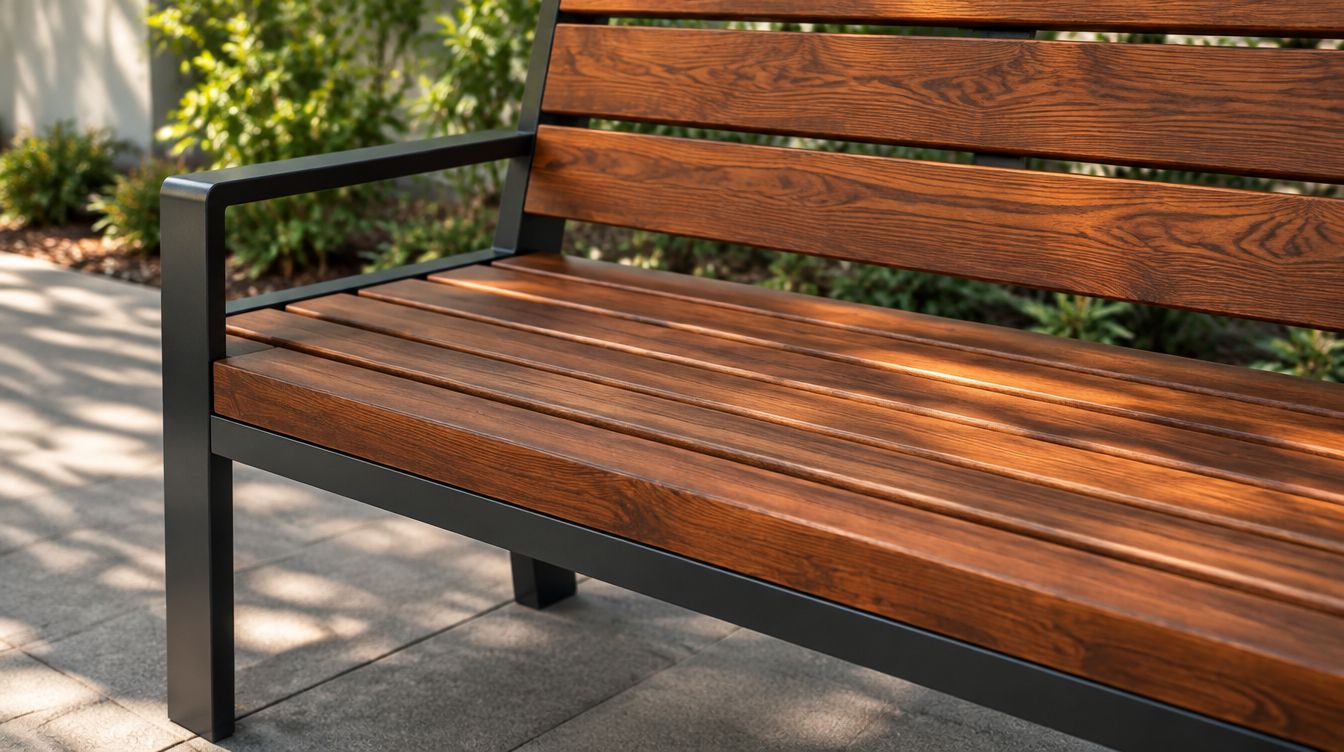
Wood is still the most popular seating surface in parks and plazas. It stays cooler in summer and warmer in winter than metal, and people simply like it. The problem has always been durability. Untreated softwood rots and moves, pressure-treated lumber raises questions about chemicals and appearance, and dense tropical hardwoods bring cost and sourcing concerns. Thermally modified wood is a fourth option that has become common on site furniture. This guide covers what it is, what it does well and where its limits are.
What thermal modification does
Thermal modification is a controlled heat treatment. Kiln-dried boards are heated in a chamber with very little oxygen, usually in steam or an inert gas so the wood does not burn. Typical treatment temperatures are around 180 to 230 °C (350 to 450 °F), held for many hours, then the wood is cooled and brought back to a stable moisture level.
The heat changes the wood's chemistry. It breaks down part of the hemicellulose, the component that most readily absorbs water and feeds fungi. The results are:
- Lower moisture uptake. The wood absorbs less water from the air, so it swells and shrinks less.
- Better dimensional stability. Less cupping, twisting and checking on slats.
- Improved decay resistance. Fungi find the modified wood much less attractive, so properly treated boards resist rot far better than the same species untreated.
- A darker colour throughout. The treatment turns the wood a warm brown all the way through, not just on the surface.
No chemicals are added. The process uses only heat and steam, which makes offcuts and end-of-life boards simpler to deal with than chemically treated lumber.
Common species
Several species are thermally modified commercially. Ash, pine, spruce, poplar and some lighter tropical plantation species are common. Hardwoods such as ash are often chosen for seating because they give a denser, tighter surface. Softwoods are lighter and more economical. When comparing products, ask for the species and the treatment level, since both affect hardness, stability and appearance.
The trade-offs
Thermal modification is not free of compromises. Plan around these:
- Reduced strength. The process makes wood somewhat more brittle and lowers its bending strength. On furniture, that means slats need adequate thickness and support spacing. Thermally modified wood should not be used as a structural member without engineering input.
- Softer than tropical hardwoods. It dents and scratches more easily than ipe or similar dense species, and it is easier to carve. In areas with heavy vandalism, consider that carefully.
- Fastener choice matters. Modified wood can be slightly more acidic than untreated wood. Use stainless steel fasteners, not plain or zinc-plated screws, which can corrode and stain.
- Pre-drilling. Because the wood is more brittle, screw holes near board ends should be pre-drilled to prevent splitting.
How it weathers
Like any wood left outdoors, thermally modified wood changes colour in sunlight. The rich brown fades over the first year or two to a soft silvery tone. This is a surface change caused by UV light. It does not mean the wood is decaying.
You have two choices:
- Let it weather. No finish, no recoating. The surface turns silver and stays that way. This is the lowest maintenance path and suits most parks.
- Keep the brown colour. Apply a penetrating exterior oil with UV protection, then reapply on a regular cycle, often once a year on sunny sites. Skipping a cycle leads to blotchy fading, so only choose this if the maintenance budget will support it.
Avoid film-forming varnishes on outdoor seating. They crack and peel, and then they look worse than bare weathered wood.
Compared with tropical hardwoods
Dense tropical hardwoods such as ipe have long been the premium choice for benches. They are extremely hard and naturally durable. Thermally modified wood competes with them in a few ways:
- Sourcing. Thermally modified wood is usually made from temperate species grown in managed forests. Tropical hardwoods need careful chain-of-custody checks, such as FSC certification, to confirm legal and responsible harvest.
- Weight. Modified wood is much lighter, which makes handling and slat replacement easier.
- Hardness. Tropical hardwoods win on dent and carve resistance.
- Cost. Prices vary with species and market, but thermally modified wood is often the more economical choice for similar appearance.
Detailing for long life
Good furniture design does as much for durability as the wood treatment. Look for:
- Gaps between slats so water, snow and debris fall through.
- Slats raised off steel supports with spacers or narrow contact edges, so water does not sit under the boards.
- Rounded edges, which wear better and are more comfortable.
- End grain that is sealed or kept out of standing water.
- Replaceable slats, fixed with tamper-resistant stainless fasteners, so one damaged board does not mean replacing the bench.
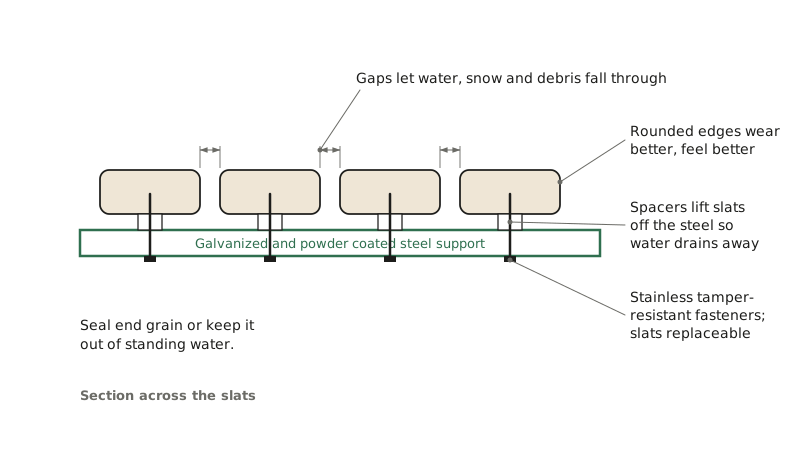
A timber slat bench on a galvanized and powder coated steel frame is a common pairing. The steel carries the load, and the wood provides a comfortable surface that is easy to swap out.
Where it fits
Thermally modified wood is a strong choice for park and plaza benches, picnic table tops and seats, and decorative cladding on planters. It is a weaker choice for parts that are struck often, such as low curbs or skateboard targets, and for any load-bearing frame. In very high vandalism areas, steel seating or recycled plastic may be easier to keep looking good.
Frequently asked questions
Is thermally modified wood the same as pressure-treated wood?
No. Pressure-treated wood has preservative chemicals forced into it. Thermally modified wood is treated with heat and steam only, and it has a uniform brown colour rather than the green or brown tint of treated lumber.
Will it splinter?
All wood can splinter as it weathers. Rounded edges, smooth sanding and periodic light sanding of rough spots keep seating comfortable. Check slats during regular inspections.
How long does it last outdoors?
Service life depends on species, treatment level, design and climate. Well-detailed seating that sheds water and has replaceable slats should give many years of service. Ask the supplier for durability data for the specific product.